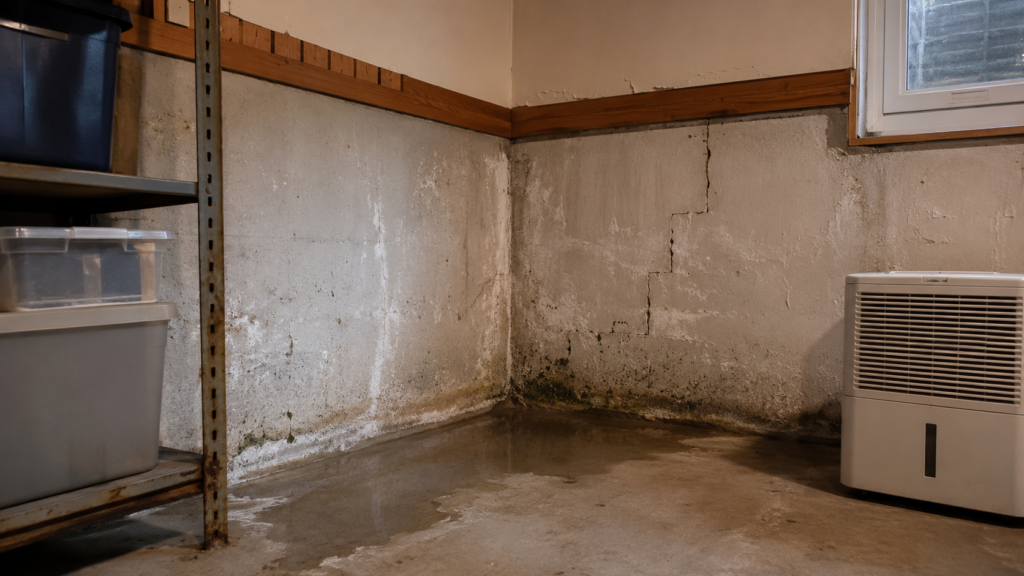
If your New Jersey basement shows any of the nine signs below, water is already getting in, and it is time to waterproof it. Some signs are urgent, others give you a little time, but none of them fix themselves.
This guide covers each sign, how to tell which ones are serious, and why waiting turns a small leak into a large repair.
The fix for most of these is a professional basement waterproofing system that manages groundwater instead of hiding it. Here is what to look for.
Several of these signs point to mold, which is a health issue as much as a home issue. The CDC reports that damp, moldy spaces can cause a stuffy nose, coughing, wheezing, and eye or skin irritation, with stronger reactions for people who have asthma or allergies.
New Jersey basements see these signs more than most. Heavy rain, a high water table, and clay-rich soils push groundwater against foundation walls, a force called hydrostatic pressure.
When that pressure builds, water finds the smallest crack or pore, and the signs above start to show.
Not every sign is an emergency, but some are. Use this table to sort what needs action now from what you can monitor, so you spend on the right fix at the right time.
The urgent signs point to active water or structural stress, while the watch signs give you room to plan.
Sign | Urgency | Why |
|---|---|---|
Standing water or puddles | Urgent | Water is in the home now and damages belongings and framing fast. |
Bowing or leaning walls | Urgent | The wall is under structural pressure and can fail if ignored. |
Visible mold or mildew | Urgent | It spreads and affects indoor air and health. |
Cracks in walls or floor | Soon | Cracks let water in and widen under pressure. Get them checked. |
Efflorescence | Soon | It confirms water is moving through the wall, even with no puddle yet. |
Musty smell or damp, humid air | Soon | A steady sign of hidden moisture that gets worse over time. |
Peeling paint or bubbling coatings | Watch | Cosmetic first, but a marker of ongoing moisture. Track it. |
Warped wood or rusting metal | Watch | A slow sign of high humidity. Note it and address the source. |
A small leak is cheap to solve. The damage it causes is not.
Water that keeps entering weakens the foundation, rots wood, and feeds mold. A hairline crack becomes a structural repair. A damp corner becomes a mold remediation job.
The guide on why you should never ignore a leaky basement walks through how fast that snowballs.
That is why early signs are the cheapest time to act. Catching water at the crack stage costs far less than repairing a bowed wall later, and our guide on how to identify and diagnose foundation cracks shows which cracks signal water pressure.
The math is simple. Sealing a crack or installing a drain is a planned, predictable cost. Replacing rotted framing, remediating mold, and rebuilding a bowed wall is an emergency cost, and emergencies are never cheap. Acting on the first sign keeps you in the planned column.
Some signs have a DIY starting point. Most do not have a DIY ending point.
You can run a dehumidifier, clean gutters, and reseal a small crack. These help, but they treat symptoms. They do not relieve the water pressure pushing against the wall, so the moisture comes back. Our guide on why your basement still feels damp after fixing leaks explains why patches fall short.
There is also a safety line. Bowing walls and standing water near electrical outlets are not DIY territory. A specialist can tell you which signs are safe to watch and which need a professional now.
A professional system manages the water at the source with an interior drain, a sump pump, and a battery backup. That is the difference between hiding the problem and solving it.
A free inspection turns guesswork into a plan. A United Waterproofing specialist checks the walls, floor, and the joint where they meet, finds where water enters, and identifies the cause.
You get a written, itemized quote with no pressure. The owner is on every job, the crew is in-house with no subcontractors, and every system carries a 100 percent lifetime transferable warranty.
As a baseline, the EPA recommends keeping indoor humidity below 60 percent. If your basement cannot hold that even with a dehumidifier, the inspection will show why.
After the inspection you get a clear recommendation and a fixed price in writing. There is no obligation, and nothing is installed until you approve the plan.
Look for the nine signs in this guide: standing water, a musty smell, efflorescence, cracks, bowing walls, damp air a dehumidifier cannot fix, mold, peeling paint, and warped wood or rusting metal. Any one of them means water is getting in and a free inspection is worth booking.
Yes. A musty smell is mold feeding on moisture. If it comes back after you air the space out, water is still entering, and a dehumidifier alone will not stop it.
Efflorescence is the white, chalky mineral salt left on walls when groundwater evaporates through concrete. It is not dangerous by itself, but it proves water is moving through the wall, so it should not be ignored.
They can be. Thin cracks let water in and widen under pressure, and horizontal or stair-step cracks can signal structural stress. Any crack that leaks or grows should be checked by a professional.
Standing water, bowing or leaning walls, and visible mold need action now. Water damages belongings and framing fast, a bowing wall is a structural risk, and mold spreads and affects health.
Yes. The CDC reports that damp, moldy spaces can cause a stuffy nose, coughing, wheezing, and eye or skin irritation, with stronger reactions for people who have asthma or allergies.
A dehumidifier lowers humidity but cannot stop water pushing in through the walls or floor. If the moisture is coming from the ground, the signs return until you waterproof.
It depends on the size of the basement, the water source, and the system. There is no single price, so the only way to get a real number is a free on-site inspection with a written, itemized quote.
A small leak rarely stays small. Ongoing water weakens the foundation, rots wood, and feeds mold, turning a low-cost fix into a structural or remediation bill.
A specialist checks the walls, floor, and wall-to-floor joint, finds where water enters, identifies the cause, and gives you a written, itemized quote with no pressure.