
Are you noticing water leaking into your basement in New Jersey after heavy rain? The most common cause of leaky basements after rain is hydrostatic pressure from water-saturated soil pushing against basement walls.
Every cubic foot of water-saturated soil weighs approximately 120 pounds. When that soil sits against an 8-foot-tall basement wall, it creates over 900 pounds of lateral pressure per linear foot, pushing water through any hairline crack in the concrete.
New Jersey’s clay-heavy soil, high water table, and above-average rainfall create persistent hydrostatic pressure that slowly erodes away basement walls.
Clay soil in northern New Jersey suffers from poor drainage and expands when saturated, increasing pressure on foundation walls.
During spring thaw and heavy autumn rain, the water table rises, and pressure intensifies, forcing water through basement walls that stayed dry during summer.
This guide explains the five primary causes of basement wall leaks in New Jersey, why they occur, and what each symptom indicates about the underlying failure.
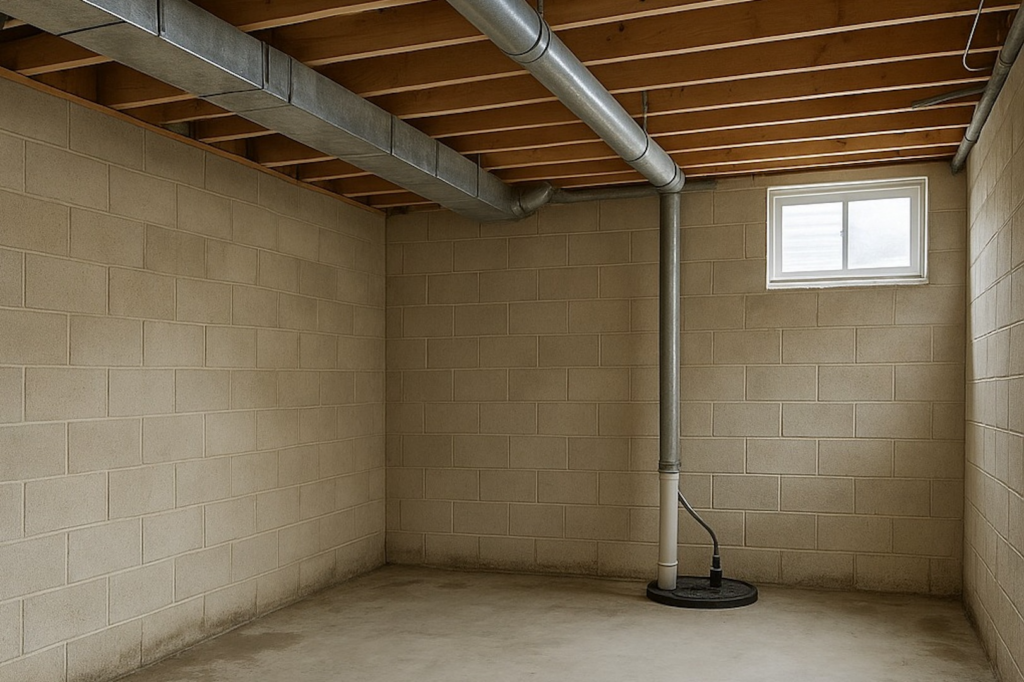
Hydrostatic pressure is the force water exerts when at rest. As the water table rises due to rain, snowmelt, or seasonal groundwater fluctuation, water accumulates in the soil around your foundation.
Water at 5 feet of depth exerts over 100 pounds per square foot of pressure. An 8-foot basement wall experiences over 160 pounds per square foot at the footing level.
This pressure does not dissipate; it remains constant as long as the water table stays elevated. Since water follows the path of least resistance, it pushes through concrete pores, cracks, and cold joints until it enters the basement.
No foundation can withstand unlimited hydrostatic pressure indefinitely. Even well-constructed basement walls eventually develop cracks and allow seepage through porous concrete without a waterproofing solution.
Reducing hydrostatic pressure requires functional drainage systems that capture and redirect water before it rises to wall height.
New Jersey sits on dense clay soil, particularly in Essex, Bergen, Middlesex, and Union counties.
Unlike sandy or loamy soil that allows water to percolate through, clay soil traps water and swells.
This expansion creates additional lateral pressure against foundation walls beyond the hydrostatic pressure from standing water.
Clay soil can expand up to 10% of its volume when saturated. A 4-foot-wide clay backfill zone can expand nearly 5 inches, pushing that mass directly against the foundation wall.
This constant pressure-and-release cycle, as soil wets and dries, causes concrete to crack, joints to separate, and walls to bow inward over time.
Cracks provide direct pathways for water to enter basement walls. The three most common types of cracks in New Jersey foundations are settlement cracks, shrinkage cracks, and structural cracks.
Settlement cracks occur when foundations settle unevenly due to soil compaction or poor footing support. These cracks are typically vertical or diagonal and widen over time.
Shrinkage cracks develop as concrete cures and loses moisture; these are usually hairline cracks that remain stable.
Structural cracks result from hydrostatic pressure, soil expansion, or frost heave and indicate the wall is moving or bowing. Horizontal cracks or stair-step patterns in block walls signal serious structural stress.
Any crack wider than 1/8 inch admits water under pressure. Even hairline cracks allow moisture vapor transmission and expand during freeze-thaw cycles.
Cracks will widen over time and admit increasing amounts of water with each rain event until they are repaired with epoxy or polyurethane injection.
The floor-wall joint—also called the cove—is where the basement floor meets the foundation wall. This joint is the most common water entry point in basements in New Jersey.
The floor and wall are poured separately during construction. Basement floors are typically poured thinner than foundation walls.
When the water table rises above the footing level, water pushes up through the floor-wall joint and emerges at the perimeter. This seepage often appears after heavy rain, then stops once the water table drops, creating an intermittent leak that homeowners misidentify as a minor issue.
Floor-wall joint leaks indicate failed or nonexistent footing drains. Properly functioning footing drains capture rising water and redirect it before it reaches floor level.
When those drains clog with silt, collapse, or are never installed correctly, water accumulates at the footing and forces its way through the cove.
Footing drains are perforated pipes installed at the base of foundation walls during construction that collect groundwater and channel it away from the foundation before it rises to the basement level.
These drains fail in three ways: clogging, collapse, or improper installation.
Clogging occurs when silt, roots, or mineral deposits block the perforations or fill the pipe. Clay soil produces fine silt that migrates into drainage systems over decades. Once a footing drain clogs, water accumulates around the foundation rather than draining away.
Collapse occurs when plastic drain tile cracks under soil pressure, cast-iron pipe corrodes, or settling soil crushes the pipe. Improper installation includes insufficient slope (pipes must slope at least 1/8 inch per foot toward the outlet), missing gravel beds (gravel prevents soil from clogging perforations), or no outlet (pipes that terminate in soil rather than daylight or a sump pit).
Many New Jersey homes built before 1980 have no footing drains at all. These foundations rely on soil absorption to manage groundwater—a system bound to fail in clay soil.
Once footing drains fail, the only solution is installing interior drain tile systems that capture water at the floor-wall joint and pump it out before it floods the basement.
Surface water contributes to basement leaks when grading directs rainwater toward the foundation rather than away from it.
Soil should slope away from the foundation at a minimum 6-inch drop over 10 feet. When grading is flat, reversed, or settles over time, rain collects against the foundation and saturates the soil immediately adjacent to basement walls.
Gutters and downspouts that discharge within 5 feet of the foundation dump hundreds of gallons of water directly into the soil next to basement walls during heavy rain.
A 2,000-square-foot roof sheds approximately 1,250 gallons of water per inch of rainfall. If that water discharges at the foundation, it overwhelms soil drainage capacity and creates localized saturation even when the general water table is low.
Correcting grading reduces surface water infiltration by up to 90% in critical zones. Extending downspouts at least 10 feet from the foundation prevents localized saturation.
These are preventive measures, not solutions for existing hydrostatic pressure, but they reduce the total water volume the drainage system must manage.
If water is leaking into your basement after heavy rain, the issue is improper water management around the foundation.
Surface-level patches and extended downspouts can temporarily relieve the issue, but if you are suffering from persistent leaks on basement floors or walls, a systematic waterproofing solution is required.
Professional waterproofing corrects underlying inefficiencies, such as poor-draining soil, hydrostatic pressure buildup, and failed drainage systems, by implementing coordinated structural and drainage improvements, including:
These methods work together to control water at its source, reduce long-term pressure against foundation walls, and prevent recurring basement leaks.
If your basement leaks after heavy rain, the problem will not resolve on its own. The pressure cycle will repeat with every storm.
Schedule a professional foundation evaluation to identify the source of failure and implement a waterproofing system designed for New Jersey conditions.
Heavy rain raises the water table and increases hydrostatic pressure against foundation walls. When pressure exceeds the capacity of drainage systems or the strength of concrete joints, water infiltrates.
During dry periods, the water table drops and pressure decreases, stopping the leak. This intermittent pattern indicates functional but overwhelmed drainage systems or minor cracks that only admit water under high pressure.
Sealing cracks from the inside stops water flow through that specific crack, but does not eliminate hydrostatic pressure. Water will find or create new entry points.
Crack repair is necessary, but must be combined with drainage systems that reduce pressure. Interior crack injection with polyurethane or epoxy works for isolated cracks, but widespread seepage requires drain tile systems and exterior waterproofing.
Winter leaks occur when frozen ground traps water against the foundation. Frost creates an impermeable layer that prevents surface water from percolating downward, causing it to pool at foundation walls.
Additionally, frozen soil expands and increases lateral pressure. When indoor heat warms the foundation slightly, ice melts, and water seeps through cracks. Winter leaks often indicate severe drainage failures.
White powder or crusty deposits are efflorescence: mineral salts left behind when water evaporates after seeping through concrete. Efflorescence indicates moisture is moving through the wall, even if no standing water is visible.
The minerals come from the concrete itself and the soil outside. Efflorescence is a symptom of water infiltration, not the problem itself. Eliminating efflorescence requires stopping moisture transmission through waterproofing.
Dehumidifiers remove moisture from the air but do not stop water from entering through walls or floors. They reduce humidity and prevent mold growth, making them useful after waterproofing is complete.
Using a dehumidifier without addressing the water source treats the symptom but not the cause. Active water infiltration overwhelms dehumidifier capacity, and the unit runs continuously without solving the problem.
Failed footing drains produce water infiltration at the floor-wall joint, especially after heavy rain. Other indicators include bowing basement walls (pressure is not being relieved), persistent dampness even in dry weather, and water entering from multiple locations along the perimeter.
A professional inspection with a camera can verify the condition of the drain, but if you have recurring leaks at the cove, the footing drains are likely failed or nonexistent.