Water in your basement is rarely the result of a single issue and usually requires both interior and exterior waterproofing systems to fix permanently.
French drains and sump pumps are two of the most commonly used waterproofing products to stop water in New Jersey basements. While both are designed to channel water away from basement footings and your foundation, they use two different processes and are installed on opposite sides of your basement wall.
Using the wrong solution wastes money and leaves your basement vulnerable to additional structural damage from water intrusion and mold.
This guide explains how each system works, how to diagnose specific waterproofing issues, and recommends when to use one solution over the other or in combination.
To understand how to fix a wet basement in New Jersey, you first have to understand the unique environmental pressures our state faces. In New Jersey, water typically enters a basement through three primary “vectors,” often simultaneously.
New Jersey’s geology features high water tables, especially in coastal and river-adjacent counties like Monmouth, Ocean, Bergen, and Middlesex. In these areas, the groundwater can sit just 3 to 6 feet below the surface.
This creates hydrostatic pressure, where the weight of the water pushes upward against your basement floor and inward against your foundation walls. This pressure forces water through vulnerable parts of your basement, including:
If left untreated, repeated pressure can cause basement walls to bow and cracks to form.
New Jersey receives over 50% more annual rainfall than the national average, often delivered via intense nor’easters or summer storms. If your yard isn’t graded correctly, this high volume of water pools against your foundation rather than draining away.
Common entry points for surface water include:
Surface water infiltration requires an interior or exterior drainage solution to channel water away from the foundation.
Much of New Jersey sits on clay-dense soil. Unlike sandy soil, which allows water to percolate downward quickly, clay absorbs water slowly and drains poorly. This causes water to “trap” against your foundation walls, where it lingers and eventually finds a path inside through capillary action or existing cracks.
A French drain is a gravel-filled trench containing a perforated pipe that collects and redirects water away from a specific area. It works using gravity to its advantage: water flows into the trench, enters the perforated pipe, and is carried downslope to a discharge point—usually a dry well, storm drain, or daylight outlet at a lower elevation on the property.
French drains do not pump water; they only route it. These are passive systems that require no electricity and work continuously as long as the grade exists to move water.
Generally, there are two types of French drains that can be installed outside or inside the property: exterior and interior drains.
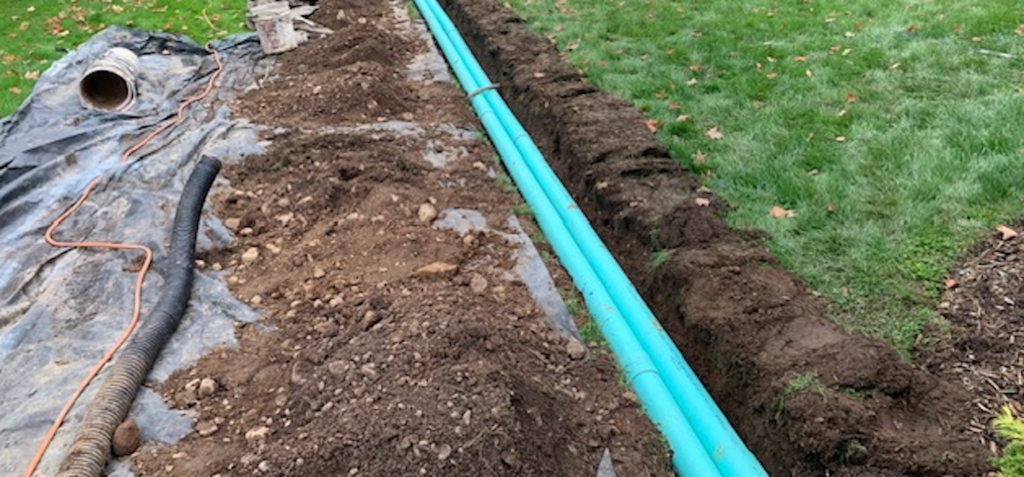
Exterior French drains are installed in the yard, typically along the foundation perimeter at or slightly below grade. They intercept surface runoff and shallow groundwater before it reaches the foundation wall.
Exterior drains work best for yards that slope toward the house, downspout discharge areas, and surface pooling after rain.
These drains are installed by digging a trench roughly 18 to 24 inches deep, lining it with filter fabric, and burying a perforated pipe encased in gravel. Collected water is then channeled safely away to a daylight outlet, dry well, or municipal storm system.
In New Jersey, homeowners can typically expect to invest between $1,650 and $12,250 for this system, depending on the length of the drain and the yard’s specific terrain.
Commonly referred to as drain tile or channel systems, interior French drains are installed beneath the basement’s concrete slab along the perimeter.
Rather than stopping water from entering through the foundation, this system captures seepage at the wall-floor joint and directs it toward a sump pit before it can spread across the floor. This is the most effective solution for New Jersey homes facing hydrostatic pressure, chronic wet-season flooding, or exterior excavation that is physically or financially impractical.
Installation typically takes one to two days and involves saw-cutting the perimeter slab, digging a trench, laying the drain tile, and pouring fresh concrete over the system. Because this method relies on a sump pump to evacuate the collected water, the two systems are almost always installed together.
In New Jersey, the average cost of an interior system ranges from $5,000 to $18,000, depending on the basement’s total perimeter length.
A sump pump is a mechanical device installed in a pit (the sump basin) at the lowest point of the basement. As water collects in the pit — from a drain tile system, natural groundwater intrusion, or both — the pump activates automatically and discharges water from the house through a pipe that terminates away from the foundation.
Unlike French drains, sump pumps require electricity to operate. This leaves them vulnerable to power outages during storms–when you need them most. Fortunately, battery backup and water-powered backup systems exist specifically to address this vulnerability.
In New Jersey, a sump pump is often the last line of defense against a flooded basement. Because our region is prone to rapid snowmelt and heavy Atlantic storm systems, choosing the right mechanical setup is critical for long-term reliability.
While the primary pump handles the heavy lifting, a complete system in New Jersey should always include a fail-safe to account for the power outages that frequently accompany our most severe weather.
Given our local climate, a backup system is a standard necessity for any professional installation.
Given our local climate, a backup system is a standard necessity for any professional installation.
These waterproofing systems address different stages of the same water problem. A French drain manages where water goes before and as it enters, while a sump pump manages water that has already collected.
Often, these systems are used in conjunction with one another for a complete waterproofing system.
The following tables compare their uses and different factors that impact when to install one system over the other.
Factor | French Drain | Sump Pump System |
Primary function | Redirects water away from the foundation | Collects and pumps water out |
Location | Exterior (yard/perimeter) or interior | Interior basement pit |
Water source addressed | Surface runoff, groundwater migration | Accumulated groundwater |
Average NJ cost | $1,650 – $12,250 (exterior) | $500 – $2,000 |
Ongoing maintenance | Low with occasional flushing | Moderate. Required pump replacement every 7–10 years |
Power required | No | Yes, a battery backup is recommended |
Works during power outage | Yes | Only with battery/water-powered backup |
Best for | Grading issues, yard pooling, perimeter drainage | High water table, active seepage, wet season flooding |
Can they be combined? | Yes — most effective when paired | Yes — sump collects what French drain channels |
Identifying the source of your water intrusion is the first step toward a permanent fix. Because New Jersey’s soil conditions vary from the sandy coast to the clay-heavy north, your symptoms provide the best clues for a solution.
Use the diagnostic table below to match what you’re seeing in your home with the likely culprit and the most effective remedy.
What You’re Seeing | Likely Cause | Recommended Solution |
Standing water in yard after rain | Poor grading or surface drainage | Exterior French drain |
Water along one basement wall after heavy rain | Surface runoff entering at grade | Exterior French drain + grading fix |
Water seeping through floor or multiple walls | High water table / hydrostatic pressure | Interior drain tile + sump pump |
Sump pit fills quickly, pump runs constantly | Water table elevation | Add battery backup; consider French drain to reduce load |
Basement floods only in wet season | Seasonal water table rise | Sump pump with battery backup |
Efflorescence (white mineral deposits) on walls | Chronic slow seepage | Interior drain system + sump pump |
Mold or musty smell, no visible water | Vapor and minor seepage | Interior drainage + dehumidification |
Water near downspout discharge points | Improper surface water management | Downspout extensions + exterior French drain |
While these diagnostics offer a helpful starting point, every New Jersey home has a unique footprint. A professional on-site assessment is the only way to confirm your specific water source and determine the precise system configuration required for your foundation type and local soil conditions.
The cost of protecting your home from water damage in New Jersey depends heavily on the specific drainage strategy required. Below are the typical price ranges and expected lifespans for residential systems in the Garden State:
System / Component | Average NJ Cost | Lifespan |
Exterior French drain (perimeter) | $1,650 – $12,250 | 20–30 years |
Interior French drain (drain tile) | $5,000 – $18,000 | 20–30 years |
Sump pump (submersible) | $500 – $2,000 installed | 7–10 years |
Battery backup sump pump | $300 – $700 installed | 3–5 years (battery) |
Water-powered backup pump | $400 – $900 installed | Long-lasting |
Combined interior drain + sump | $5,000 – $20,000 | System: 20+ years |
Exterior + interior full system | $10,000 – $30,000+ | 25+ years |
These ranges reflect residential installations in New Jersey. Some common variables we encounter that increase costs include a finished basement requiring demolition and restoration, multiple discharge points, and high-water-table areas requiring oversized sump basins.
In New Jersey’s varied climate, a single waterproofing solution is often insufficient. Most New Jersey-based waterproofing professionals recommend a dual-system approach in the following scenarios:
A properly paired system that manages surface water, collects seepage, and evacuates collected water with a sump pump addresses all three vectors of water entry that Garden State homes face. It is also the configuration most likely to qualify for a lifetime transferable warranty, which adds resale value.
A French drain is a passive gravity-fed system that redirects water away from a structure using a perforated pipe in a gravel trench. A sump pump is a mechanical device that collects accumulated water in a pit and pumps it out. French drains address where water flows; sump pumps address water that has already collected. Most New Jersey homes with chronic wet basements benefit from both.
Exterior French drains in New Jersey typically cost $1,650 to $12,250, depending on trench length and terrain. Interior drain tile systems (sometimes called interior French drains) cost $2,000 to $18,000. Both ranges reflect residential properties: commercial and multi-unit pricing start higher.
A standard submersible sump pump with installation costs $500 to $2,000 in New Jersey, according to Home Advisor. Adding a battery backup system runs $300 to $700 more. A full interior drain tile system feeding into a new sump pit typically costs $5,000 to $12,000 as a combined project.
Not in most New Jersey homes. French drains manage surface runoff and shallow groundwater, but they cannot address hydrostatic pressure from a high water table. If your basement floods during wet seasons, regardless of surface conditions, a sump pump is necessary; the water table is rising into the basement from below, not entering from the surface.
Properly installed French drains last 20 to 30 years. The most common failure mode is silt infiltration through damaged or inadequate filter fabric. Root intrusion from nearby trees is the second most common cause of failure. Annual inspection of discharge points helps catch problems early.
Yes. New Jersey averages more than 30 significant storm events annually, and power outages during heavy rain are common, exactly when sump pump demand peaks. A battery backup adds $300 to $700 to the installation cost and provides 6 to 12 hours of pump operation during an outage.
Either system, properly installed, provides long-term control. Drainage systems manage ongoing water pressure; they do not eliminate the conditions that create it.
Yes, particularly when paired with a transferable warranty. A documented, warrantied drainage system removes a major buyer objection at inspection. Homes with active seepage or no drainage documentation face price reductions of $10,000 to $30,000 or deal collapses during inspection. A functioning, warranted system eliminates that risk and is a net positive on appraisal.
Basic surface-level French drains for yard drainage are within reach of experienced DIYers. Foundation-level exterior French drains and all interior drain tile systems require professional installation; improper installation affects foundation integrity, voids warranties, and can create drainage problems elsewhere on the property. For basement water management specifically, professional installation is the right call.