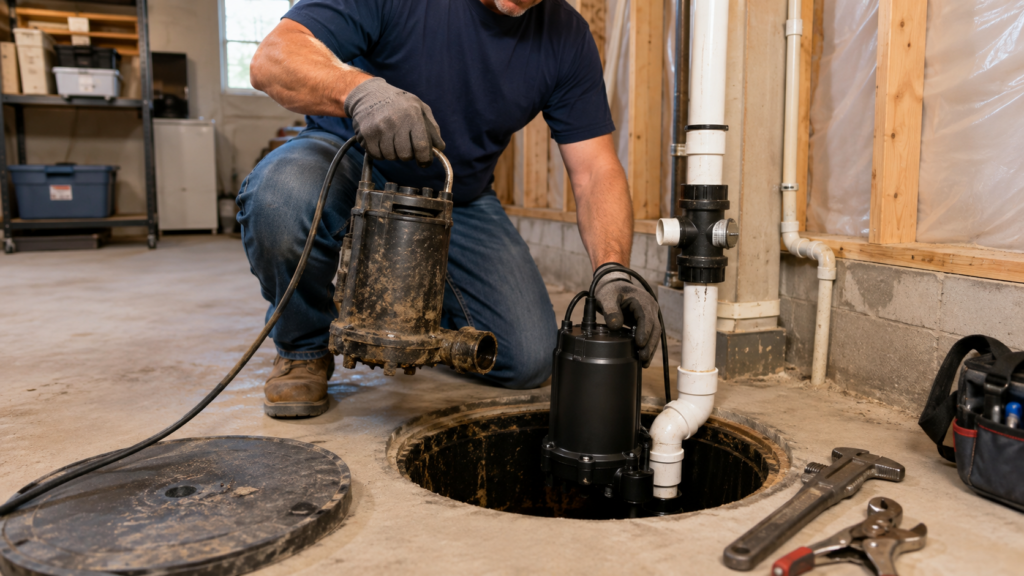
Replacing a sump pump in a New Jersey home typically costs a few hundred dollars to around $1,000 for a like-for-like swap in an existing pit. A brand new installation, with a pit, discharge line, and drainage, usually runs from about $1,000 to $4,000 or more. A battery backup adds several hundred to over $1,000, and in NJ it is the part you should not skip. The exact number depends on the pump, the pit, and how the water leaves your house.
A sump pump is one piece of a larger system. It only protects your basement if the drainage feeding it works, which is why the pump is best judged as part of a complete basement waterproofing system. This guide breaks down the costs, the warning signs of a dying pump, and the questions that get you an honest quote.
The price difference comes down to labor. A replacement drops a new pump into an existing pit. A new install builds the pit, the drainage, and the discharge from scratch.
Job | Typical NJ range | What the price covers |
|---|---|---|
Like-for-like replacement | A few hundred dollars to about $1,000 | A new pump installed in the existing pit, connected to the existing discharge line. |
Replacement with upgrades | Roughly $800 to $2,000 | A higher-capacity pump, a new check valve, a sealed lid, or a reworked discharge line. |
New installation | About $1,000 to $4,000 or more | Breaking the slab, digging the pit, setting the basin, and running the discharge line. |
Battery backup add-on | Several hundred to over $1,000 | A second pump and battery that run when the power fails or the main pump cannot keep up. |
These are planning ranges, not quotes. The only real number is a written, itemized quote after an inspection of your pit, your water volume, and your discharge route.
Four factors move the number up or down.
Quality matters as much as size. United Waterproofing installs rust-proof composite sump tanks and high-capacity pumps with battery backup, and you can see the equipment on our waterproofing products page. Cheap pumps are cheap for a reason, and the failure usually arrives mid-storm.
Most sump pumps last about 7 to 10 years. Age is the first signal, but the pump usually warns you before it quits. Replace it when you notice:
The worst time to learn your pump is dead is during the storm that kills it. If your pump shows any of these signs heading into the wet season, replace it on your schedule, not the weather’s.
The storm that floods your basement is the same storm that knocks out your power. A primary pump with no backup dies at the exact moment you need it most.
That is not a rare event in New Jersey, where nor’easters, thunderstorms, and hurricane remnants take down power lines every year. Ready.gov advises every household to plan for outages with alternative power sources, and for a basement, that means a battery-powered second pump.
The math favors the backup. FEMA reports that just one inch of water can cause up to $25,000 in damage. Against that number, a battery backup that costs several hundred dollars is the cheapest insurance in the house.
A handy homeowner can swap a pump, but the risk is not in the swap. It is in what you cannot see.
A professional sizes the pump to the water, tests the full cycle, and checks whether the surrounding drainage is doing its job. Our guide to the types of basement drainage systems explains how the pieces work together.
Skip the guesswork and get the number in writing. A United Waterproofing specialist inspects the pit, the pump, the discharge line, and the drainage around them, then hands you a written, itemized quote with every part and price listed.
The inspection is free, there is no obligation, and the owner is on every job with an in-house crew and no subcontractors. Every system is backed by a 100 percent lifetime transferable warranty.
A like-for-like replacement in an existing pit typically runs a few hundred dollars to about $1,000. Upgrades such as a higher-capacity pump or a new check valve push the range toward $2,000. The exact price depends on the pump, the pit, and the discharge line.
A new installation usually runs from about $1,000 to $4,000 or more, because it includes breaking the slab, digging the pit, setting the basin, and running the discharge line. A written, itemized quote after an inspection gives you the real number.
Most sump pumps last about 7 to 10 years. Heavy use, hard water, and cheap components shorten that. Once a pump passes 7 years, plan its replacement instead of waiting for a failure.
Constant cycling, grinding or rattling noises, visible rust, a stuck float, and weak water flow are the common warnings. A pump that shows any of these before the wet season should be replaced on your schedule, not during a storm.
Yes. The storms that flood basements are the same storms that cause power outages, and a primary pump is useless without electricity. FEMA reports that one inch of water can cause up to $25,000 in damage, which makes a backup one of the cheapest protections a home can have.
It depends on how much water your drainage collects during a heavy storm. An undersized pump floods the basement, and an oversized one short-cycles and wears out early. A professional sizes the pump to the measured water volume.
You can swap the unit, but sizing, the check valve, and the discharge route are where DIY jobs go wrong. A failing pump is also often a sign the drainage around it cannot keep up, which a new pump alone will not fix.
Constant running usually means a stuck float switch, an undersized basin, a failed check valve letting water drain back, or more groundwater than the system can handle. An inspection identifies which one is at fault.
A working sump system with a battery backup makes a home easier to sell, because a dry basement removes a common buyer objection. Pairing it with a transferable warranty adds documented value at resale.
A specialist checks the pump, pit, float, check valve, discharge line, and the drainage feeding the pit, then provides a written, itemized quote. There is no obligation, and nothing is installed until you approve the plan.