Repairing a bowing basement wall in New Jersey typically costs $3,000 to $8,000 with carbon fiber straps, $4,000 to $12,000 with steel I-beams, $5,000 to $15,000 with wall anchors, and $15,000 to $40,000 or more if the wall has to be rebuilt. National cost guides put individual carbon fiber straps at roughly $350 to $1,000 each and wall anchors at $700 to $1,500 each, and New Jersey projects often run toward the upper end of those ranges. The method, and the price, depend on how far the wall has moved.
A bowing wall is a structural problem and a water problem at the same time, and fixing one without the other fails. Professional foundation repair stabilizes the wall, and a waterproofing system relieves the pressure that bent it. This guide covers what causes bowing, what each repair method costs, how much movement is too much, and how to get a structural inspection and a written quote.
Two forces push basement walls inward, and New Jersey has plenty of both. The first is hydrostatic pressure, which is the sideways and upward force of water-saturated soil against a foundation. After heavy rain or snowmelt, the ground outside your basement holds water like a sponge, and that water pushes on the wall with a force that grows with depth. Block walls, which are common in homes built from the 1950s through the 1980s, have mortar joints that give under that pressure.
The second is clay expansion. Clay soils swell when they absorb water and shrink when they dry, and much of northern and central New Jersey sits on clay and glacial till. Each wet season the soil expands against the wall, and each dry spell it pulls back, so the wall is pushed and released over and over. Over years, that cycle produces a horizontal crack near mid-height, then a visible inward bulge.
Frost adds a third push in winter, when water in the soil freezes and expands. Poor grading, clogged gutters, and downspouts that dump at the foundation make all three forces worse by feeding more water into the soil against the wall.
Each method matches a range of movement. Using a lighter method on a wall that has moved too far is the most common and most expensive mistake, because the repair fails and the wall keeps moving.
Method | Typical NJ range | Best for | Disruption |
|---|---|---|---|
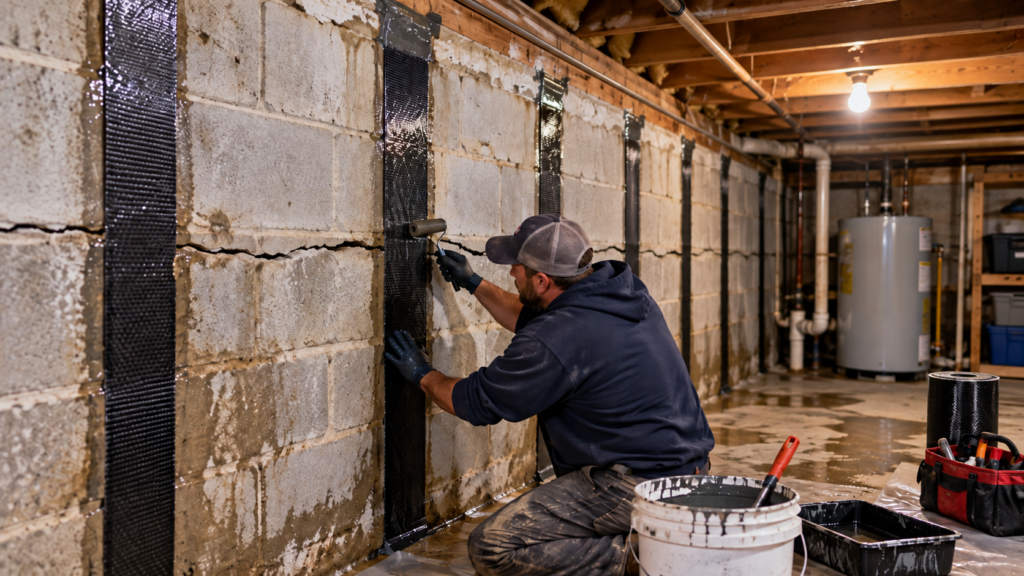
Carbon fiber straps | $3,000 to $8,000 per wall | Bowing under about 1 inch with no shearing. Stops further movement. | Low. Installed from inside, bonds flat to the wall, can be finished over. |
Steel I-beams | $4,000 to $12,000 per wall | Bowing of 1 to 2 inches. Braces the wall against the floor and joists. | Low to moderate. Interior install, beams stay visible unless framed around. |
Wall anchors | $5,000 to $15,000 per wall | Bowing of 1 to 2 inches or more where yard access allows. Can gradually straighten the wall. | Moderate. Requires exterior excavation for each anchor plate. |
Wall rebuild | $15,000 to $40,000+ | Walls that have sheared, shifted off the footing, or moved beyond repair. | High. Excavation, shoring, and new wall construction. |
These are planning ranges drawn from national cost data and adjusted for New Jersey labor and soil conditions. The only number that matters is a written, itemized quote after a structural inspection of your wall.
A system installed before finishing addresses every path water takes into a basement.
United’s patent-pending system uses Fast Flow perforated piping, a rust-proof composite sump tank, and a battery backup, all installed from inside with no excavation. You can see the components on our waterproofing products page. Because the work is interior, it happens before the framing goes up and never disturbs the finished result.
The deflection, which is how far the wall has moved inward from straight, decides the repair. Measure it by holding a long straightedge or a taut string vertically against the wall and checking the gap at the widest point.
Any bowing deserves a professional look, because the wall does not stop moving on its own. Horizontal cracks and stair-step cracks in block are the early warning. The guide on how to identify and diagnose foundation cracks shows which crack patterns signal pressure and which are cosmetic.
Bracing a wall treats the symptom. The force that bent it is still in the soil, pushing every wet season. If the water pressure is not relieved, carbon fiber can delaminate, beams can shift, and the wall keeps leaking even if it stops moving. That is why a lasting repair pairs wall stabilization with drainage.
An interior basement waterproofing system relieves hydrostatic pressure by collecting the water at the wall-to-floor joint and pumping it out before it builds against the wall. Exterior grading and downspout extensions reduce how much water reaches the soil in the first place. Together with the structural repair, they stop the cycle instead of pausing it.
The cost of skipping that step is real. FEMA reports that just one inch of water in a home can cause up to $25,000 in damage. A braced wall that still lets water through delivers both the structural bill and the water bill.
Within each method, five factors move the quote up or down.
Ask any contractor to show how each factor appears in the quote. A number that cannot be explained line by line is a number to question.
Book a free inspection. A specialist measures the deflection, maps the cracks, checks whether blocks have shifted, and looks at the soil, grading, and drainage outside. For walls near or past 2 inches, a structural engineer’s evaluation may be recommended before any method is chosen.
The quote should name the method, list every strap, beam, or anchor and its price, include the waterproofing that protects the repair, state the timeline, and spell out the warranty. In New Jersey, home improvement contracts over $500 must be in writing and must carry the contractor’s state registration number, which starts with 13VH. You can verify any contractor’s registration through the state’s license lookup before signing.
Bowing walls get worse with every wet season, and fall storms are coming. Schedule a free structural inspection or call (973) 343-2086 to get a written quote while the fix is still a brace and not a rebuild. Wall repairs are eligible for GreenSky® financing, subject to credit approval.
Typically $3,000 to $8,000 with carbon fiber straps, $4,000 to $12,000 with steel I-beams, $5,000 to $15,000 with wall anchors, and $15,000 to $40,000 or more for a rebuild. New Jersey projects often run toward the upper end because of labor and clay soil conditions.
Hydrostatic pressure from water-saturated soil and the swelling of clay soils push the wall inward, and winter frost adds a third force. Poor grading and downspouts that dump at the foundation make all three worse.
Under 1 inch can usually be stabilized with carbon fiber. Between 1 and 2 inches needs steel beams or wall anchors. Over 2 inches, or any sheared or shifted blocks, calls for a structural engineer and possibly a rebuild.
Yes, for walls that have moved under about 1 inch with no shearing. The straps bond to the wall and stop further movement, but they do not straighten it and are not enough once the wall has moved more than an inch.
They can, gradually. Anchors are tightened over time, often during dry seasons when the soil has relaxed, and can pull a wall partway or fully back toward plumb. They require yard access for the exterior plates.
Yes. Bracing treats the symptom, but the water pressure that bent the wall is still in the soil. An interior drainage system relieves that pressure, and without it the repair can fail and the wall keeps leaking.
Carbon fiber and steel beam installs usually take one to two days. Wall anchors take two to three days because of the exterior excavation. A rebuild can take a week or more.
Usually not. Standard homeowners policies exclude damage from groundwater pressure, soil movement, and gradual deterioration. Prevention through drainage and early repair is the practical protection.
Home improvement contractors must register with the NJ Division of Consumer Affairs and display a 13VH registration number on contracts. Verify it through the state's license lookup, and insist on a written, itemized quote with warranty terms.
As soon as you see a horizontal or stair-step crack or any inward bulge. Walls do not stop moving on their own, and early repair with carbon fiber costs a fraction of beams, anchors, or a rebuild later.