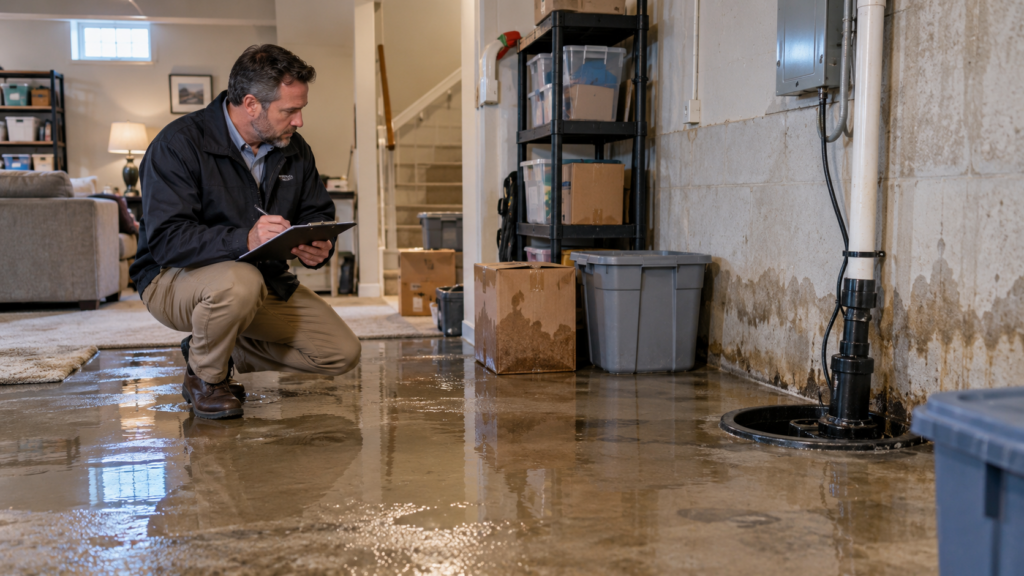
Usually not, because standard New Jersey homeowners policies exclude flood damage and groundwater seepage, which together cause most basement water problems. A policy generally pays for sudden, accidental events inside the house, such as a burst pipe, and not for water that rises from the ground or comes in from outside.
That gap is why prevention matters more than a claim. A basement waterproofing system stops the water that insurance will not pay for. This guide explains what standard policies cover, how flood insurance treats basements, what a water backup rider adds, and how to document a loss if one happens.
The dividing line is the water source. Sudden and internal is usually covered. Gradual, external, or from the ground is usually not.
Water source | Standard policy | Why |
|---|---|---|
Burst pipe or failed water heater | Usually covered | A sudden, accidental event inside the home. |
Roof leak from storm damage | Often covered | Damage to the structure from a covered peril, though the roof itself may not be. |
Groundwater seepage through walls or floor | Excluded | Considered gradual water intrusion, not a sudden event. |
Flood from rivers, runoff, or storm surge | Excluded | Flood is a separate peril that requires a flood policy. |
Sewer or drain backup, sump pump failure | Excluded unless endorsed | Covered only with a water backup rider added to the policy. |
Mold from any of the above | Limited or excluded | Most policies cap or exclude mold unless it results from a covered loss. |
New Jersey regulators require insurers to remind you of this. The NJ Department of Banking and Insurance rule at N.J.A.C. 11:1-5.5 requires every homeowners insurer to notify policyholders at least once a year that the policy does not cover flood damage, and it defines flood to include the rapid accumulation or runoff of surface water from any source.
Less than most homeowners expect. FEMA’s National Flood Insurance Program basement fact sheet defines a basement as any area with a floor below ground level on all sides, and it limits coverage there to specific items.
Two more rules matter. A flood, for NFIP purposes, is water covering two or more acres or two or more properties, so a single wet basement from seepage does not qualify. And a new flood policy carries a 30-day waiting period, so it cannot be bought in front of an approaching storm.
A water backup and sump overflow endorsement is an add-on to a homeowners policy. It covers damage when water backs up through sewers or drains, or when a sump pump fails or overflows. It is not flood coverage, and it does not cover groundwater seeping through the foundation.
The rider is worth having, but it has limits. Coverage caps are often modest, and a failed pump still means a flooded basement before the claim is paid. A working pump with a battery backup prevents the loss the rider would reimburse.
United Waterproofing installs high-capacity pumps in rust-proof composite sump tanks with battery backup, so the system keeps running through the storms that also cut the power. You can see the equipment on our waterproofing products page.
Because it closes the gap where insurance stops. Groundwater seepage, the most common NJ basement problem, is excluded from homeowners policies, does not qualify as a flood, and is not covered by a backup rider. No policy pays for it. A waterproofing system prevents it.
Prevention also protects the things no policy replaces well: finished basements, stored belongings, time, and the disruption of a claim. A claim, if it is paid at all, comes with a deductible, a wait, and often a premium increase at renewal.
The cost comparison favors prevention. Most NJ interior systems run about $2,500 to $10,000 once, with a lifetime transferable warranty. Our guide on why you should never ignore a leaky basement shows how fast an uninsured leak grows into a structural or mold bill.
If water does get in, the first hours decide whether a covered loss gets paid.
A waterproofing system lowers both the chance of a loss and the cost of insuring against one.
A free inspection from United Waterproofing identifies where water enters, explains what a policy would and would not cover, and provides a written, itemized quote for closing the gap. Schedule your free inspection before the next storm tests your coverage.
Usually not. Standard policies exclude flood damage and groundwater seepage, which cause most basement water problems. They generally cover sudden internal events such as a burst pipe.
No. Seepage through walls or the floor is treated as gradual water intrusion and is excluded. It is also not covered by flood insurance or a backup rider, which is why waterproofing is the only real protection against it.
Only partly. NFIP building coverage pays for items such as the furnace, water heater, sump pump, and unfinished drywall, plus cleanup. Finished walls, floors, ceilings, and personal belongings in a basement are not covered.
Under the NFIP, a flood is water covering two or more acres or two or more properties. Water in one basement from seepage does not qualify, and a new flood policy has a 30-day waiting period.
It covers damage from sewer or drain backup and from a sump pump that fails or overflows. It does not cover flood or groundwater seepage, and coverage limits are often modest.
Rarely in full. Most policies cap or exclude mold unless it results from a covered loss. The NJ Department of Banking and Insurance notes that mold coverage is usually a separate, optional extension.
Yes. Under N.J.A.C. 11:1-5.5, New Jersey homeowners insurers must notify policyholders at least annually that the policy does not cover flood damage, including rapid runoff of surface water.
Photograph water lines, damaged items, and the source before cleanup, record appliance model and serial numbers, call your insurer promptly, keep damaged materials until the adjuster approves disposal, and save every receipt.
It can help. A documented system with a battery backup reduces claim risk, which supports better terms, and it avoids the premium increases that follow water claims.
For seepage, insurance pays nothing, so waterproofing is the only option. Most NJ interior systems cost about $2,500 to $10,000 once, with a lifetime transferable warranty, compared with FEMA's estimate of up to $25,000 in damage from one inch of water.