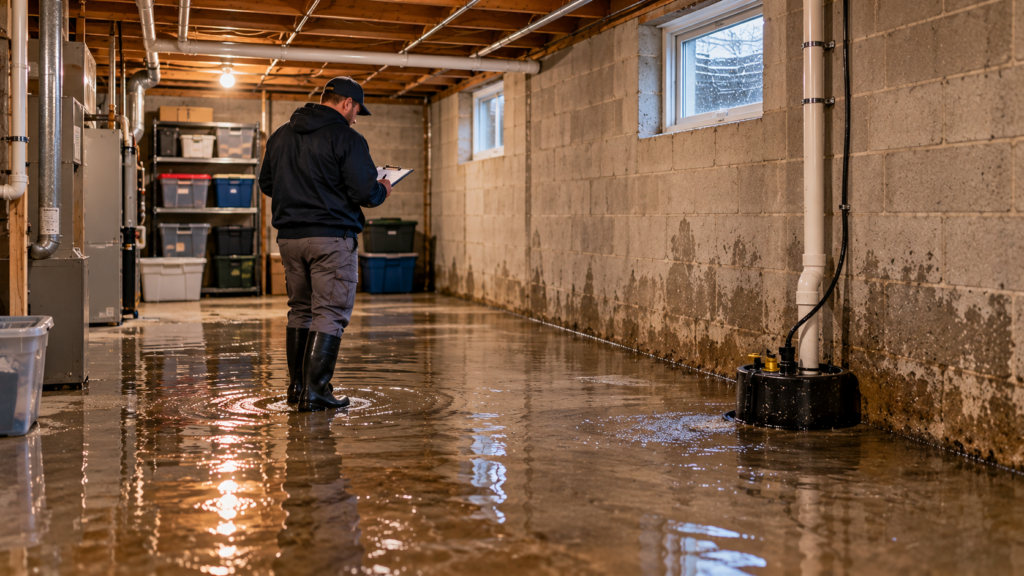
If your New Jersey basement is flooding, the order of calls is safety first, then water removal, then a waterproofing contractor, then your insurer. Call 911 if anyone is hurt or you smell gas. Call an electrician or your utility if water is near outlets, the panel, or appliances and you cannot shut off power from a dry spot. Call a water-removal service to pump and dry the space, a waterproofing contractor to find and fix the source, and your insurer once you have photos and a clear picture of what happened.
A pump-out gets the water out. It doesn’t stop the next storm from bringing it back. The permanent fix is a basement waterproofing system that manages groundwater before it reaches the floor. This guide walks through the safety steps, who to call and in what order, why floods repeat, and how to make this the last one.
Water and electricity in the same room is the real emergency. Before anyone goes down the stairs, deal with the power.
These steps follow the CDC’s guidelines for reentering a flooded home, which are clear on the key point: never turn power on or off, or use an electric tool, while standing in water, and call an electrician if the main switch is only reachable through standing water.
Use this table to match what you are seeing with who to call. Most basement floods involve two or three of these calls, in this sequence.
Situation | Who to call | Why |
|---|---|---|
Anyone hurt, or a gas smell | 911, then the gas utility | Life safety comes before property every time. |
Water near outlets, the panel, or appliances and no dry path to the breaker | Licensed electrician or electric utility | Only a professional should cut power that can only be reached through water. |
Sewage smell or water backing up through floor drains | Municipal sewer or water utility, then a plumber | A main line backup is the utility’s problem, and a house line clog is the plumber’s. |
Several inches of standing water | Water removal and drying service | Pumps out the water and dries the space within the window that prevents mold. |
Water came through walls, the floor, or the wall-to-floor joint | Basement waterproofing contractor | Finds the source and installs the system that stops the next flood. |
Damage to belongings or finishes | Your insurance agent | Documents the loss and tells you which policy, if any, applies. |
Call the waterproofing contractor the same day you call for water removal. Emergency schedules fill fast after a regional storm, and the inspection can happen while the space is still drying. A specialist who sees the water lines and entry points fresh gets a clearer diagnosis than one who sees a dry basement a week later.
A restoration crew removes water and dries the structure, and that work matters. Federal mold guidance says wet materials need to be dried within 24 to 48 hours to prevent mold, so fast extraction protects your health and your finishes. What it does not do is change anything about why the water came in.
Groundwater that entered through the wall-to-floor joint under hydrostatic pressure, which is the sideways and upward force of saturated soil against the foundation, will enter the same way the next time the ground saturates. A pump-out handles this storm. A drainage system with a sump pump and battery backup handles every storm after it. Paying for the first without the second means paying for the first again.
Basements that flood once almost always flood again, because the conditions that caused it are permanent features of the property.
Each flood also makes the next one worse by widening cracks and weakening materials. The guide on why you should never ignore a leaky basement shows how quickly repeated water turns into structural and mold damage.
The visit after a flood has three parts, and the first two happen before anything is sold.
Ask whether the crew is in-house or subcontracted, whether the owner will be on the job, and whether the warranty is lifetime and transferable to a future owner. After a flood, those answers tell you whether you are buying a system or a sales pitch.
Prevention is a system, not a product. Three components work together, and skipping any one of them leaves a gap the next storm finds.
Ready.gov makes the same point in its flood preparedness guidance, advising homeowners to install check valves and consider a sump pump with a battery. Add exterior grading that slopes away from the house and downspouts that discharge well past the foundation, and the water that used to end up in your basement never reaches the wall.
The sump pumps, rust-proof composite tanks, and battery backups built for New Jersey storms are shown on the waterproofing products page. Early October is the moment to act, ahead of nor’easter season and the tail end of hurricane season. Schedule a free post-flood inspection or call (973) 343-2086 and make this the last time the basement floods.
Call 911 if anyone is hurt or you smell gas. If water is near electrical outlets, the panel, or appliances and you cannot shut off power from a dry location, call an electrician or your utility. Then call a water removal service, a waterproofing contractor, and your insurer.
Not until the power is off. Never enter standing water that may be in contact with outlets, the panel, or plugged-in appliances, and never operate the breaker while standing in water. Call an electrician if the main switch is only reachable through water.
Yes, if you can reach the main breaker from a dry spot. If reaching it means standing in water, do not touch it. Call an electrician or your electric utility to cut the power.
A water removal or restoration service pumps out standing water and dries the structure. Drying within 24 to 48 hours matters for preventing mold, but the pump-out does not stop the next flood.
Call your municipal sewer or water utility first, since a main line backup is their responsibility. If the problem is in your house line, a plumber clears it. Treat the water as contaminated and keep people and pets out.
The soil, water table, and entry points that caused the first flood are permanent. Clay soils hold water, the water table stays high after wet weather, and cracks and the wall-to-floor joint stay open until a system manages the water.
No. It removes the water from one storm. A drainage system with a sump pump and battery backup prevents the water from reaching the floor in the next one.
Inspects the walls, floor, and joint, reads the water lines, tests any existing sump, checks exterior grading and downspouts, identifies exactly how water entered, and provides a written, itemized quote for a system that prevents it.
Install an interior perimeter drain, a sump pump sized to the water volume, and a battery backup, then fix grading and downspouts outside. Each part covers a gap the others cannot.
Usually not for groundwater seepage or flood, which standard policies exclude. Sudden internal events such as a burst pipe are often covered, and a water backup rider can cover sump failure. Call your agent with photos to confirm what applies.