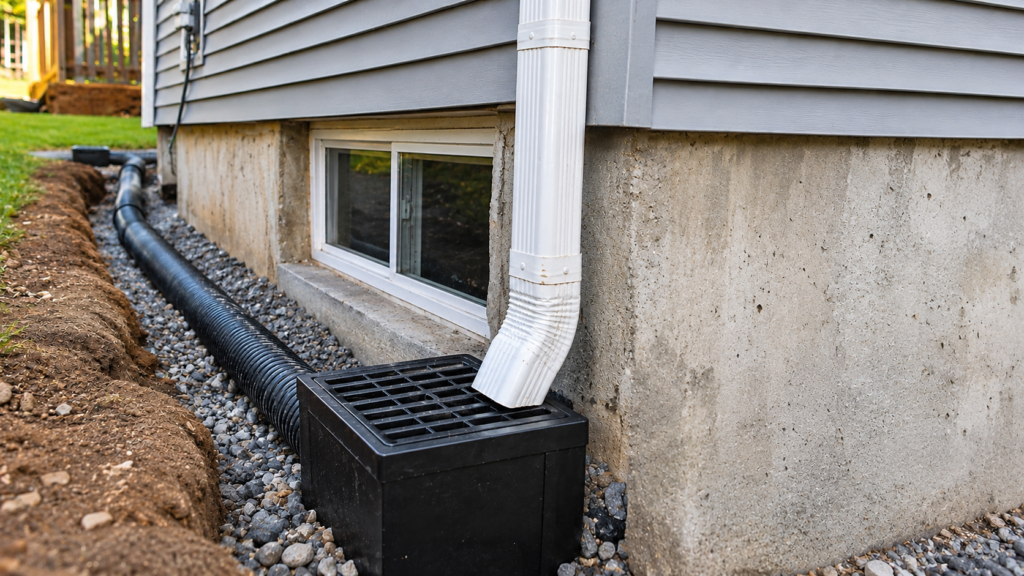
Exterior basement drainage in New Jersey typically costs $20 to $50 per linear foot for a shallow exterior French drain, which puts most whole-house runs between $2,500 and $8,000. Downspout extensions run $50 to $300 each, regrading the soil around a foundation runs $1,000 to $5,000, a dry well runs $1,500 to $5,000 installed, and a full footing-depth exterior drain with excavation and a wall membrane runs $8,000 to $20,000 or more. The right mix depends on where the water is coming from, and the cheapest fixes are often the first ones to try.
Exterior drainage manages water before it reaches the foundation. Interior drainage manages water after it does. The comparison in the guide to interior vs exterior basement waterproofing covers the methods. This guide covers what the exterior side costs in 2026, what drives the number, which small fixes pay off first, when exterior work alone is enough, and why November is the month to get it done.
Exterior drainage is priced by the foot and by the depth. A shallow trench along a wet side of the house is a different job from excavating to the footing around the whole foundation.
Factor | Lower cost | Higher cost |
|---|---|---|
Linear feet | One problem side of the house, 30 to 60 feet. | The full perimeter, 120 to 200 feet or more. |
Depth | A shallow surface drain 12 to 24 inches deep that catches runoff. | A footing-depth drain 6 to 8 feet deep that relieves groundwater at the wall base. |
Excavation | Hand-dug trench in open lawn. | Machine excavation, removing and restoring patios, walks, decks, and landscaping. |
Discharge | Gravity flow to daylight on a sloped lot. | A dry well, a pump, or a long run to reach a legal discharge point on a flat lot. |
Discharge is the factor that surprises people on flat lots. A drain only works if the water has somewhere lower to go. On sloped ground that is a pipe to daylight. On the flat valley lots common across central New Jersey it means a dry well or a pump, which adds cost and a mechanical part that needs maintenance.
Three low-cost fixes solve a surprising share of basement water problems, because they address roof water and surface runoff, which is where much of the water near a foundation comes from.
Fix | Typical NJ cost | What it solves |
|---|---|---|
Downspout extensions | $50 to $300 each | Roof water dumping at the foundation. Extensions carry it 6 to 10 feet away. Often the single best dollar spent. |
Regrading | $1,000 to $5,000 | Soil that slopes toward the house. The ground should fall about 6 inches over the first 10 feet away from the wall. |
Dry well | $1,500 to $5,000 | Downspout or drain water with nowhere to go on a flat lot. A buried chamber lets it soak into the ground away from the foundation. |
Shallow exterior French drain | $20 to $50 per foot | Surface and near-surface runoff collecting along one side of the house. |
Try the extensions and the grading first. If the basement still takes on water after a heavy rain with the roof water carried away and the soil sloping correctly, the problem is groundwater rising from below, and surface fixes will not reach it.
Each method is the right answer to a different question. Exterior work pays off when the water is arriving at the wall from outside and above. Interior work pays off when the water is rising from below.
The guide to the types of basement drainage systems walks through the components on each side. For most New Jersey homes with recurring water, the practical sequence is cheap exterior fixes first, then an interior system if water keeps coming.
Because clay does not drain. Much of northern and central New Jersey sits on clay and glacial till that absorb water slowly and hold it for weeks. The NRCS Web Soil Survey maps these soils parcel by parcel, and across Morris, Somerset, and the river valleys the drainage class comes back as somewhat poorly to poorly drained again and again.
In that ground, an exterior drain catches what reaches it and the rest of the water sits in the soil, pushing against the wall and under the slab with hydrostatic pressure, which is the sideways and upward force of saturated soil against the foundation. Water that is already below the drain depth, or rising from the water table beneath the floor, never meets the exterior pipe. An interior perimeter drain at the footing, tied to a sump pump with battery backup, is what relieves that pressure. The full interior basement waterproofing process shows how that system captures water at the joint before it reaches the floor.
The cost of guessing wrong is real. FEMA reports that just one inch of water in a home can cause up to $25,000 in damage, and an exterior drain that misses the groundwater delivers that bill on top of its own.
Exterior drainage is a digging job, and November is the last comfortable month to dig in New Jersey. Once the ground freezes, excavation slows, trenches cave, backfill will not settle, and most crews stop exterior work until spring.
Timing also protects the system. Grading and extensions installed before winter move snowmelt away from the foundation in March, which is when the water table peaks and basements flood. A drain finished in November has been through one freeze-thaw cycle by the time spring rain arrives, and any settling has been corrected. Waiting until spring means competing for crews during the busiest weeks of the year, with a basement that has already gotten wet.
Start with a free inspection that looks at both sides of the wall. A specialist should check where water appears inside, then walk the exterior to see where roof water lands, how the soil slopes, where the lot discharges, and what the soil is made of. That visit decides whether the answer is a downspout extension, a drain, an interior system, or a combination.
Ask for a quote that prices the exterior and interior work as separate line items, lists the linear feet and depth of any drain, names the discharge method, and states the warranty. A number that bundles everything into one figure hides what you are buying. Ask whether the crew is in-house, whether the owner is on the job, and whether the system is backed by a lifetime transferable warranty. Schedule a free inspection or call (973) 343-2086 while the ground is still soft enough to work.
A shallow exterior French drain runs $20 to $50 per linear foot, or about $2,500 to $8,000 for most whole-house runs. A footing-depth exterior drain with excavation and a wall membrane runs $8,000 to $20,000 or more. Downspout extensions, regrading, and dry wells cost far less and often solve the problem.
About $20 to $50 per linear foot for a shallow drain in open lawn. Footing-depth drains that require machine excavation and restoring patios or landscaping cost several times that.
Typically $1,000 to $5,000 depending on the length of wall and how much soil must be added. The goal is ground that falls about 6 inches over the first 10 feet away from the house.
Roughly $1,500 to $5,000 installed. A dry well gives downspout or drain water a place to soak into the ground on a flat lot where gravity discharge is not possible.
Yes, and they are the cheapest fix available at $50 to $300 each. Roof water dumping at the foundation is one of the most common causes of basement seepage, and carrying it 6 to 10 feet away solves a surprising share of problems.
Neither in every case. Exterior drainage handles water arriving from outside and above. Interior drainage handles groundwater rising from below. In NJ clay, interior systems handle most recurring problems, and the two are combined on the wettest lots.
Usually because the water is coming from below the drain. Clay soil holds water that pushes under the slab and through the wall base, and an exterior pipe above that level never meets it. An interior perimeter drain at the footing relieves that pressure.
Rarely. Frozen ground slows excavation, trenches cave, and backfill will not settle, so most crews stop exterior work until spring. November is the last practical month, while interior systems install year round.
Often not for grading and extensions. Drains that connect to a storm sewer, discharge to a street, or involve significant excavation can require municipal approval. Ask the contractor who pulls any permit and confirm the discharge point is legal.
Linear feet and depth of any drain, the discharge method, exterior and interior work priced as separate line items, the timeline, and the warranty in writing. Ask whether the crew is in-house and the owner is on the job.