Bowing basement walls in New Jersey are primarily caused by hydrostatic pressure, which occurs when the soil surrounding your foundation becomes saturated with water and expands, exerting thousands of pounds of lateral force against the structure.
To fix bowing basement walls in New Jersey, you must stabilize the structure and manage the soil pressure pushing against your foundation.
Fixing bowed or unstable walls requires a multi-step process:
New Jersey famously suffers from poorly draining, clay-rich soils, including Boonton and Passaic soil series, which contain dense “fragipan” layers that severely restrict downward water drainage and amplify lateral pressure against basement walls.
Combined with rainfall exceeding 50 inches annually in the northern and central parts of the state, poorly reinforced basement walls and outdated waterproofing methods leave your foundation vulnerable to horizontal cracks and structural shifting.
To address bowing walls, a combination of foundation repair and modern waterproofing is required to both reinforce the structure and redirect the water that causes this damage.
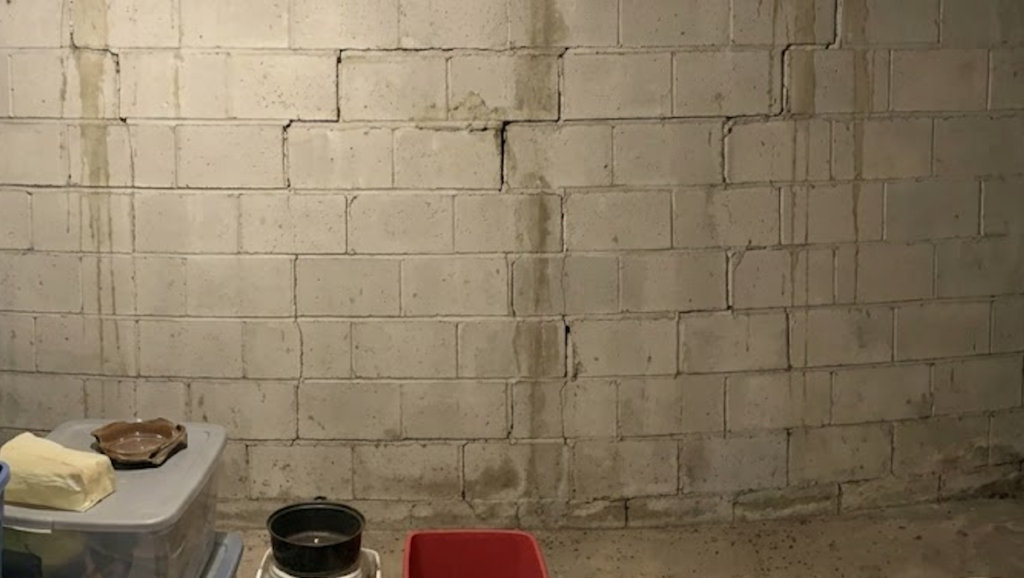
Over time, these forces create horizontal cracks at mid-wall height—the point of maximum lateral bending stress—and the wall begins to rotate inward at the base.
In addition, invasive tree root systems and settlement of older foundations can also cause basement walls to shift and lean inward.
Identifying the problem early is the difference between a $5,000 repair and a $40,000 wall rebuild. Look for these early warning signs in your basement:
Horizontal cracks running across the middle or lower portion of a basement wall are the most serious warning sign of structural problems. They form at the point where lateral soil pressure is bending the wall, and their presence means the wall has already begun to move. The longer and wider the crack, the further the movement has progressed.
A horizontal crack in a basement wall is a structural emergency, not a cosmetic issue. Do not fill it with hydraulic cement and consider it resolved. The crack is a symptom of ongoing pressure, and the wall will continue to move without reinforcement or repair.
In concrete block (CMU) foundations, stair-step cracks running diagonally along mortar joints indicate that blocks are shifting relative to each other. This pattern often accompanies bowing and signals that the wall is losing structural integrity at the mortar joints: the weakest points in block construction.
Hold a long level or straight edge against the wall. If the wall curves inward—even slightly—it is bowing. A plumb line dropped from the top of the wall to the floor is a simple field test: any gap between the line and the wall mid-section confirms movement.
Hold a long level or straight edge against the wall. If the wall curves inward—even slightly—it is bowing. A plumb line dropped from the top of the wall to the floor is a simple field test: any gap between the line and the wall mid-section confirms movement.
Foundation movement transmits force through the structure above it. Doors or windows that suddenly stick, frames that pull away from walls, or drywall cracks appearing on upper floors can all indicate that foundation movement is affecting the superstructure. By this point, the issue extends well beyond the basement.
The right repair method depends on the severity of the damage stage, the foundation type (poured concrete vs. concrete block), and site conditions. Here is how each method works and when it applies.
For early-stage bowing, carbon fiber straps offer a high-tech, low-profile solution. These straps are bonded vertically to the interior face of the wall with a high-strength epoxy, creating reinforcement that is 10 times stronger than steel in tension.
While carbon fiber cannot pull a wall back to its original position, it is incredibly effective at halting further inward movement. This method is a favorite for finished basements in New Jersey because it requires no yard excavation and can be easily painted over. In the New Jersey market, homeowners can expect to pay between $3,000 and $8,000 for a single wall.
Wall plate anchors are a robust two-part system designed for severe cracking. A steel plate is bolted to the interior wall and connected by a steel rod to an anchor plate buried in the soil of your yard.
This is the only non-excavation method that can actively restore a wall’s position; the rods can be tightened over time to gradually pull the wall back toward plumb at a rate of roughly 1/4 inch per season.
Wall anchors are an ideal choice for properties with accessible yard space, though they are not suitable for tight urban lots or attached homes. Costs typically range from $4,000 to $12,000 per wall.
When plate anchors aren’t practical due to property lines, Steel I-beams (or channel anchors) provide a heavy-duty internal bracing system. These beams are installed vertically against the wall and anchored into the floor slab and the floor joists above to redistribute the lateral load.
While the beams remain permanently visible, they offer a permanent structural fix without the need for outdoor digging. For a single-wall installation in New Jersey, the price typically ranges from $5,000 to $12,000.
For poured concrete walls in significant distress, helical tiebacks offer a sophisticated exterior anchoring solution. These large steel rods with screw-like plates are drilled through the foundation wall and deep into the stable soil beyond the active pressure zone.
Instead of bracing the wall from the inside, they pull and anchor it from the outside. This is particularly useful in Northern Jersey, where interior space may be limited but deep, stable soil is reachable. Because this requires specialized drilling equipment, the cost is higher, typically ranging from $6,000 to $15,000.
When a wall has reached total failure—typically characterized by more than 3 inches of movement or severe deterioration—a full wall rebuild becomes the only safe option. This involves shoring up the structure above, demolishing the failing wall, and replacing it with new poured concrete.
While this is the most disruptive and expensive option, with costs ranging from $15,000 to over $50,000, it provides a total structural reset. A rebuild also offers the unique advantage of allowing contractors to integrate modern, high-performance waterproofing and drainage systems directly into the new foundation.
While carbon fiber or steel beams provide the strength to hold the wall in place, they do not remove the source of the movement: water.
By installing an interior drainage system and a high-capacity sump pump, you divert the hydrostatic pressure away from the foundation before it can exert force against your new reinforcements.
Think of it as a dual-defense strategy: the foundation repair fixes existing damage, while waterproofing prevents future damage.
Without addressing the source of bowing walls, even the strongest steel braces will remain under constant, unnecessary stress.
While minor settling is common in older homes, any horizontal crack in a basement wall warrants a professional assessment within 30 days. The following conditions are emergencies requiring immediate support to prevent further damage to your basement:
Ignoring a bowing wall only leads to more invasive and expensive repairs as the lateral soil pressure continues to mount. Addressing these issues early with a combination of structural reinforcement and modern waterproofing is the only way to permanently stabilize your home against New Jersey’s challenging soil conditions.
United Waterproofing offers free foundation assessments to help New Jersey homeowners navigate these repairs with confidence. Our structural specialists will precisely measure wall movement, identify the specific source of hydrostatic pressure, and provide a written repair recommendation before any commitment is required.
Run a straightedge or level along the wall, both horizontally and vertically. Any inward curve indicates bowing. Horizontal cracks at mid-wall height are the most reliable visual indicator. A plumb line dropped from the ceiling to the floor will show any inward deviation at the mid-wall section.
Yes, at any stage beyond minimal deflection. A bowing wall under active lateral pressure is a structural member that is failing. At Stage 3 (2+ inches of movement) or Stage 4, collapse risk is real. The wall is not going to stabilize on its own; it will continue moving until it is repaired or it fails.
Foundation repair in New Jersey ranges from $3,000 to $8,000 for carbon fiber strap stabilization on a single wall to $20,000 to $50,000 for a full wall rebuild. Most mid-range repairs—wall anchors or steel I-beams for an active bowing wall—run $5,000 to $15,000. Combined foundation repair and waterproofing projects typically cost $12,000 to $35,000.
Yes, if caught early before substantial deflection has occured. Wall plate anchors allow gradual correction over multiple seasons by tightening a rod that pulls the wall outward. Carbon fiber straps and I-beams do not restore the wall to its original position. At later stages of disrepair, straightening the wall typically requires rebuilding it.
A cracked wall has fractures but may not have moved. A bowing wall has physically displaced inward. They often occur together; horizontal cracks are typically the first sign that a wall is beginning to bow. The crack itself is less important than what it indicates about wall movement.
Standard homeowners' insurance excludes foundation movement caused by soil pressure, settling, or hydrostatic pressure. Coverage may apply if sudden structural damage results from a covered event like a burst pipe, but chronic foundation movement is treated as a maintenance issue and is excluded.
Carbon fiber strap installation takes 1 day for a single wall. Wall anchor systems take 1 to 2 days. Full I-beam installations run 1 to 3 days, depending on wall length. Partial or full wall rebuilds take 3 to 10 days and may require structural shoring of the floors above during the work.
Repairing the wall closes the cracks that allow water entry, but it does not eliminate the hydrostatic pressure that caused both the bowing and the water intrusion. A drainage solution (interior drain tile and sump pump) is needed to relieve that pressure permanently. Foundation repair without drainage leaves the underlying cause intact.