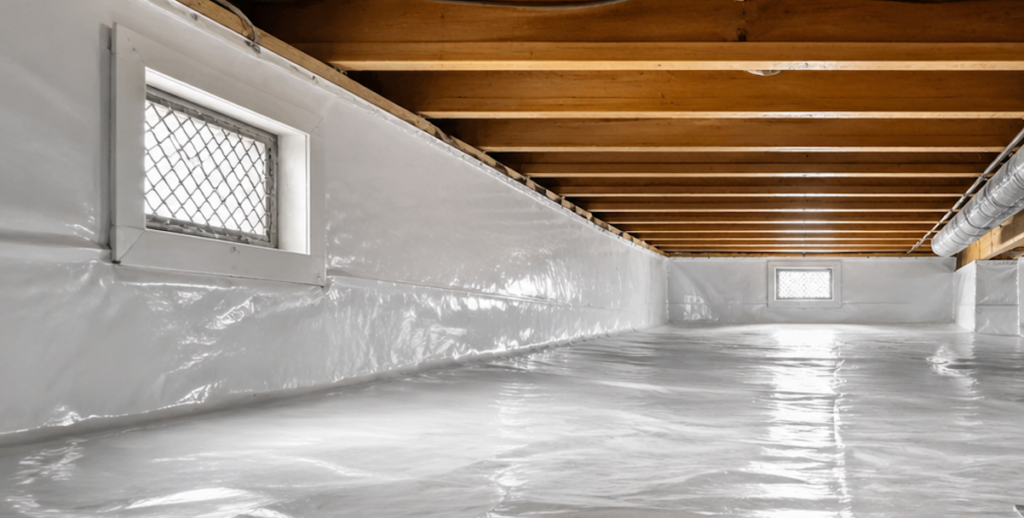
The most effective way to prevent crawl space moisture in New Jersey is with crawl space encapsulation. This process seals the crawl space with a heavy-duty vapor barrier, closes all foundation vents, and controls residual humidity with a dedicated dehumidifier.
Venting, the traditional approach, inversely makes moisture worse in New Jersey’s climate, which is why encapsulation is recommended.
The reason is straightforward physics. Vented crawl spaces are designed for dry climates where outdoor air is drier than the air it replaces inside. In New Jersey, average relative humidity exceeds 60% for the majority of the year.
Warm, humid summer air entering through foundation vents contacts the cooler crawl space surfaces, reaches its dew point, and condenses, depositing liquid water on floor joists, subfloor sheathing, and insulation. Ironically, the vents designed to remove moisture end up creating it.
A U.S. Department of Energy study monitoring crawl spaces across multiple climate zones found that sealed, conditioned spaces consistently maintained relative humidity below the 70% mold-growth threshold, while vented crawl spaces in humid climates showed elevated wood moisture content in structural framing.
New Jersey falls in IECC Climate Zone 4A (Mixed-Humid)—the zone where the research most clearly favors encapsulation. In fact, New Jersey’s Residential Construction Code allows sealed crawl spaces with mechanical ventilation as a code-compliant alternative.
Learn why encapsulation is the preferred method to prevent crawl space moisture and signs your crawl space and basement require encapsulation.
For decades, the standard building practice in New Jersey was to install foundation vents under the impression that airflow would dry the crawl space. However, we now know that in our Mixed-Humid climate (IECC Climate Zone 4A), venting often does more harm than good.
During New Jersey’s humid summers, open vents allow warm, moisture-laden air to enter the cool crawl space, where it condenses on floor joists and insulation, creating a breeding ground for mold and wood rot.
Encapsulation solves this by completely sealing the space off from external elements. By treating the crawl space as a conditioned part of your home, you eliminate the stack effect (where dirty crawl-space air is pulled up into your living areas) and gain complete control over humidity levels.
While venting is a passive approach that relies on luck, encapsulation is a proactive system designed for long-term structural protection.
Feature | Passive Venting | Full Encapsulation |
Moisture Control | Poor; often increases humidity in summer. | Excellent; maintains steady RH below 55%. |
Air Quality | Allows allergens, dust, and outdoor pollutants in. | Acts as an air seal; prevents the “stack effect.” |
Energy Efficiency | High heat loss in winter; hard on HVAC. | Significantly reduces monthly utility bills. |
Pest Risk | Open vents provide easy access for rodents/insects. | Sealed barriers deter pests and wood-boring insects. |
Structural Integrity | Risk of wood rot and sagging floors over time. | Keeps floor joists dry and structurally sound. |
Maintenance | Minimal (but damage goes unnoticed). | Annual dehumidifier filter changes. |
Understanding which moisture source dominates at your property determines which part of the encapsulation system does the most work for your crawl space.
Encapsulation is a system of components, not a single product. Each component addresses a specific moisture pathway.
A 12 to 20-mil reinforced polyethylene liner covering the entire crawl space floor and extending up foundation walls to at least 6 inches above grade. Seams overlap by at least 12 inches and are taped with moisture-resistant tape. The liner eliminates ground evaporation: the primary moisture driver in most NJ crawl spaces.
Unfortunately, hardware-store 6-mil sheeting tears easily and allows moisture migration through micro-perforations. Professional-grade material is the difference between a system that lasts 5 years and one that lasts 25.
All existing foundation vents are sealed with rigid foam insulation panels cut to fit and sealed at the perimeter with spray foam. This eliminates the outdoor air condensation source.
Without vent sealing, a vapor barrier on the floor does not prevent summer condensation on the joists and foundation walls above it.
In a vented crawl space, insulation sits between floor joists to keep the floor above warm.
In an encapsulated crawl space, insulation moves to the foundation walls, treating the crawl space as a semi-conditioned space. This keeps floor joists warmer and drier, reducing the wood moisture content that drives structural decay and mold growth in older homes.
Even a well-encapsulated crawl space accumulates some moisture through liner seams, air leakage, and incidental sources. A dedicated crawl space dehumidifier maintains relative humidity below 60%—the threshold above which mold growth accelerates. Most quality units include a condensate pump that discharges collected water to the exterior.
For crawl spaces with active groundwater intrusion, such as visible standing water, wet soil, or water staining on foundation walls, a perimeter drain directed to a sump pit must be installed before the vapor barrier goes down. This sequence matters: encapsulating over wet conditions traps water beneath the liner.
Crawl space moisture operates out of sight. By the time most New Jersey homeowners notice a problem, it has typically been ongoing for years.
Common signs that your crawl space has a moisture problem include:
The cost of crawl space encapsulation in New Jersey typically ranges from $5,000 to over $15,000, depending on the property’s specific needs.
A basic setup involving a heavy-duty vapor barrier and vent sealing generally costs between $2,500 and $5,000, which is suitable for homes with moderate moisture and no history of standing water.
For the majority of New Jersey residents—especially those with HVAC equipment located below the first floor—a system including a dedicated dehumidifier and condensate pump is recommended, bringing the investment to between $4,000 and $7,500.
In cases where a home suffers from active groundwater intrusion or a high water table, a comprehensive system requiring interior drainage and a sump pump can exceed $15,000.
While these upfront costs vary based on your home’s size and condition, hiring a professional waterproofing company to perform encapsulation saves you money in the long run.
By creating a permanent air seal and managing humidity, you can reduce your annual heating and cooling expenses by 15% to 25% while preventing costly structural repairs from wood rot and mold remediation.
Encapsulate. New Jersey's climate zone (Mixed-Humid, IECC 4A) is precisely the condition where venting makes moisture worse. Outdoor summer air adds more moisture to the crawl space than it removes. The New Jersey building code allows sealed crawl spaces as a code-compliant alternative to vented crawl spaces when mechanical moisture control is provided.
Yes, by eliminating the primary moisture sources that allow mold to establish itself. Encapsulation eliminates ground evaporation and outdoor-air condensation. A dehumidifier that maintains relative humidity below 60% prevents mold from finding the conditions it needs. Existing mold on structural members must be remediated before encapsulation.
Yes. The Department of Energy estimates 15 to 25% reductions in heating and cooling costs for homes with previously vented crawl spaces. The mechanism is two-part: reduced conditioned-air leakage through floor penetrations and more stable floor-surface temperatures that reduce the heating and cooling load the HVAC system must compensate for.
A properly installed system with professional-grade materials lasts 20 years or more. The vapor barrier liner is the primary factor in longevity. 20-mil reinforced liners far outlast hardware-store products. The dehumidifier requires regular maintenance (filter cleaning, annual service) and has a typical service life of 8 to 12 years before replacement.
Laying a vapor barrier is within reach for a capable DIYer in a dry, accessible crawl space. The full system involves enough technical decisions that improper execution defeats the purpose.