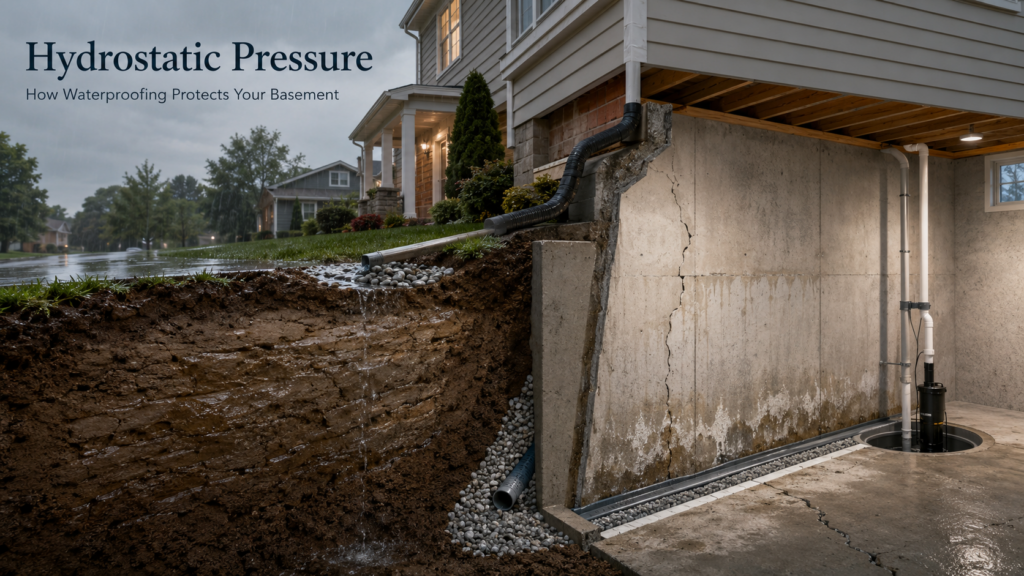
The best way to address hydrostatic pressure exerted on your foundation walls is to relieve water buildup with a full waterproofing system.
Exterior waterproofing solutions help stormwater runoff travel away from your foundation rather than pooling around it. Common solutions include installing French drains, extending downspouts six feet away from the foundation, and regrading the soil to slope away from the structure.
For water that seeps beneath your foundation or around your basement walls, interior waterproofing products, such as sump pumps and tile drains, can relieve pressure and help maintain your basement’s structural integrity.
Hydrostatic pressure is an ongoing threat to basements in New Jersey, as the northern and central parts of the state sit atop slow-draining Boonton and Carlisle soils. These clay-heavy soils are characterized by poor drainage, which allows the ground to swell with water and exert hydrostatic pressure on nearby structures.
This guide discusses how hydrostatic pressure damages basements in New Jersey and what solutions homeowners can implement to prevent further pressure buildup.
Hydrostatic pressure is the force exerted by water-saturated soil against your foundation walls and floor. It is the primary cause of basement water intrusion, foundation cracking, and wall bowing in New Jersey homes.
The word hydrostatic comes from the Greek for water (hydro) and standing (static).
When the ground around your foundation becomes saturated with water after rain or during snowmelt, the saturated soil exerts pressure on every vertical and horizontal surface of the foundation. The deeper the foundation, the greater the pressure at its base.
Hydrostatic pressure acts on foundation structures in three ways: as a lateral force on vertical walls, as an uplift force on horizontal slabs, and as a penetration force driving water through any available gap.
Each produces distinct damage patterns that New Jersey homeowners and their inspectors should recognize.
Lateral hydrostatic pressure pushes inward against foundation walls. Poured concrete and concrete block walls are designed to resist a certain amount of this force, but the region’s clay soils can generate pressures that exceed design limits, particularly on older foundations not built to current standards.
The damage progression is predictable: first, horizontal or diagonal cracking appears as the wall begins to flex.
As pressure continues and the crack widens, the wall begins to bow or tilt inward. Without intervention, inward deflection progresses until the wall approaches a point of structural failure.
This is why horizontal foundation cracks are treated as urgent: they indicate that lateral pressure is actively deforming the wall structure.
Hydrostatic pressure acts on the basement floor slab from below and on the walls from the sides. Upward pressure on the slab, combined with the slab’s own weight, can cause basement floor cracking, slab heaving at specific locations, and seepage through cracks in the floor.
Floor crack patterns associated with hydrostatic uplift are typically diagonal or random rather than straight.
Seepage through the wall-floor junction—where the wall meets the floor—is one of the most common water entry points as a direct result of differential pressure between the wall and the floor slab.
Even without crack formation, hydrostatic pressure forces water through any existing gap in the foundation structure. Block wall mortar joints, pipe penetrations, window well frames, tie holes from formwork, and the cold joint at the wall-footing pour are all potential entry points.
This penetration shows up as efflorescence (white mineral deposits left on the wall surface as water evaporates) and as water staining, dark patches on the concrete block.
Even when there is no standing water on the basement floor, efflorescence and wall staining indicate active hydrostatic pressure moving water through the foundation material itself.
New Jersey’s specific geological characteristics create higher sustained pressure than in many other regions, which is why basement water problems are so common throughout the state.
A properly designed system—combining exterior management with interior relief—is the only way to ensure these geological factors don’t compromise your home’s structural integrity.
Eliminating hydrostatic pressure entirely is technically not possible—water will always be present in the soil around foundations. The goal of foundation waterproofing is to manage that pressure to prevent damage to the structure.
Waterproofing relieves hydrostatic pressure by intercepting water before it builds to damaging levels, directing it away from the structure, and ensuring it is discharged safely.
An interior drainage system intercepts water at the footing level before it reaches your basement floor. While it doesn’t stop pressure from forming outside, it creates a path of least resistance, relieving the internal force that pushes water through cracks and at the wall-floor junction.
High-capacity piping captures and channels seepage directly to a sump pit, providing the most reliable defense against the heavy clay soils found throughout the region.
The sump pump is the heart of your waterproofing system, responsible for discharging all collected groundwater away from the home. Because the heaviest storms often trigger power outages, a pump is only as reliable as its power source.
Installing a battery backup as a standard feature ensures your system continues to relieve hydrostatic pressure even when the grid fails.
Installed at the footing level outside the foundation, a French drain intercepts groundwater before it ever touches your walls. This is the most effective way to reduce pressure rather than just managing it after it enters.
While this requires significant excavation and is often reserved for new construction or major structural overhauls, it offers the highest level of protection by keeping the soil around your foundation dry.
When pressure causes visible damage like bowing or cracking, structural repairs must be paired with waterproofing to be effective.
Specialized carbon fiber straps can stabilize walls, while epoxy injections seal cracks and wall anchors restore structural alignment.
Repairing the damage without addressing the underlying hydrostatic pressure is only a temporary fix; a complete solution must treat both the physical symptom and the source of the pressure.
Hydrostatic pressure is the force exerted by water-saturated soil against your foundation. It pushes laterally against walls and upward against the floor. In New Jersey, heavy clay soils hold significant moisture, making this pressure the leading cause of basement leaks, bowing walls, and foundation cracks.
Common warning signs include horizontal cracks in foundation walls, seepage at the joint where the wall meets the floor, and efflorescence, which is a white, powdery mineral deposit on the walls. You may also notice inward bowing of basement walls or floor cracks with visible moisture or heaving.
Yes. When the weight of the water in the soil exceeds the strength of your concrete or block walls, the structure will fail. Lateral pressure causes horizontal and diagonal cracks, while upward pressure can shatter floor slabs. Left untreated, this pressure will continue to widen existing gaps and cause further structural instability.
The most effective solution for homeowners is a defense-in-depth approach. This includes an interior drainage system to intercept water at the footing, a high-capacity sump pump with battery backup to discharge the water, and consistent exterior maintenance such as clearing gutters and extending downspouts.
Waterproofing manages the pressure rather than removing the water from the earth entirely. Since New Jersey soil will always hold some moisture, a professional system provides a path of least resistance, safely channeling water away before it builds up enough force to damage your home.