For most New Jersey homes, interior basement waterproofing is the practical choice. It manages groundwater from the inside, costs less than exterior work, and does not require digging up your yard.
Exterior waterproofing has its place, but it is a bigger, more expensive job that fits a narrower set of situations.
New Jersey’s heavy rain and high water table make basement water a common problem, so the method you choose has real consequences for cost and disruption.
This guide compares the two methods on cost, disruption, and lifespan so you can see which one your home needs. If you want the basics first, start with our guide on how basement waterproofing works.
The two methods solve the same problem from opposite sides of the wall.
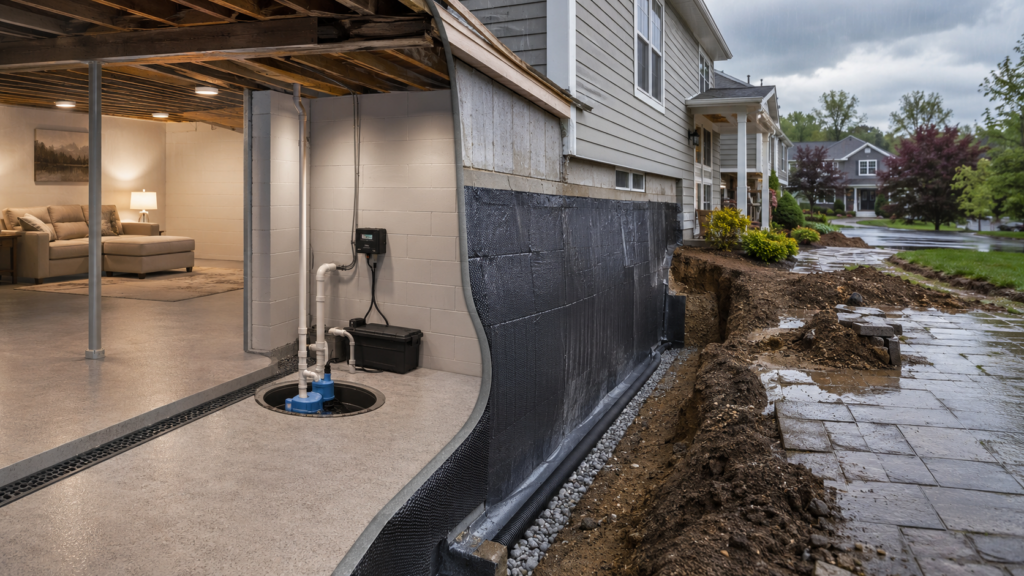
An interior system manages water after it reaches the foundation. A technician installs a drainage channel under the slab around the inside edge of the basement, routes it to a sump pit, and a sump pump sends the water outside.
A battery backup keeps it running during storms. This relieves hydrostatic pressure, which is the sideways and upward push of saturated-soil groundwater against your foundation. The channel sits below the slab, so it collects water at the exact point where the wall meets the floor, which is where most seepage appears.
An exterior system stops water before it reaches the wall. A crew excavates the soil down to the footing, applies a waterproof membrane to the outside of the foundation, and installs an exterior drain to carry water away. It addresses water at the source, but it requires digging around the whole foundation.
For a closer look at the drainage options within each method, see our guide on the types of basement drainage systems. Good exterior drainage also starts at the surface. The Department of Energy’s Building America program recommends grading the final soil so it slopes away from the foundation.
In New Jersey, most basement water comes from below, as groundwater rises through the floor and the wall-to-floor joint. That is why interior systems handle the majority of local cases, while exterior work is the exception rather than the rule.
Here is how the two methods stack up on the factors that matter most.
Factor | Interior waterproofing | Exterior waterproofing |
|---|---|---|
Cost | Lower. Less labor and no excavation. | Higher. Excavation is labor-intensive. |
Disruption | Low. Work stays inside, so no landscaping is torn up. | High. Digging around the foundation disturbs yards, patios, and walkways. |
Install time | Often one to three days. | A week or more, weather permitting. |
Best fit | Groundwater seepage, high water table, finished or unfinished basements. | Failing exterior membrane, water entering over the top of the wall, new construction. |
Weather | Can be installed year round. | Weather-dependent, and hard in frozen or saturated ground. |
Lifespan | 20-plus years with basic maintenance. | Long-lasting, but repairs mean digging again. |
The pattern is clear. Interior waterproofing wins on cost, speed, and disruption, while exterior waterproofing wins when the water problem starts outside the wall. For the typical NJ home fighting a high water table, that points to an interior system.
Whichever method you choose, a system is only as good as its upkeep. An interior sump should be tested before each wet season and its discharge line kept clear, and a service plan keeps the system working long after install.
Your basement decides the method, not the other way around. Ask three questions.
If cracks or bowing walls come with the water, the plan may combine waterproofing with foundation repair, since water pressure and structural damage often travel together.
There is no single right answer for every home, and an honest contractor will tell you when exterior work is worth the extra cost. In practice, most NJ basements are dried and kept dry with an interior system, and exterior work is reserved for the cases that truly need it.
Most New Jersey water problems come from a high water table and heavy rain pushing groundwater through the foundation. An interior system is built for exactly that.
United Waterproofing uses a patent-pending interior waterproofing system that captures water before it reaches your foundation, with Fast Flow perforated piping, a rust-proof composite sump tank, and a battery backup. It is faster, less disruptive, and less costly than excavation, and it carries a 100 percent lifetime transferable warranty.
Because the work is done from inside, the crew installs the system without tearing up your yard or waiting for dry weather. The owner is on every job, and the in-house team handles the work from start to finish, with no subcontractors.
Exterior work is the right call in specific cases.
Even in these cases, the two methods often pair together. An exterior membrane stops water at the wall, while an interior drain relieves any pressure that still builds beneath the slab, so the basement stays dry from both directions.
For an existing NJ home with groundwater seepage, an interior system solves the problem with less cost and less disruption. The EPA notes that controlling moisture is the key to controlling mold, and an interior system does that from the inside.
Neither is better in every case. Interior waterproofing fits most NJ homes with groundwater seepage, because it costs less and is less disruptive. Exterior waterproofing fits homes where water enters over the top of the wall or the outside membrane has failed.
Interior waterproofing is cheaper. It uses less labor and needs no excavation, while exterior work requires digging around the foundation, which drives up cost and time.
Yes. An interior system collects groundwater at the wall-to-floor joint, routes it to a sump pump, and sends it outside. This relieves the water pressure that pushes moisture through the foundation.
Most interior systems are installed in one to three days, depending on the size of the basement and the prep involved. A free inspection gives you an exact timeline.
Usually, yes. Exterior work requires excavating the soil around the foundation, which disturbs landscaping, patios, and walkways that then need to be restored.
Both can last for decades. Interior systems run 20-plus years with basic maintenance. Exterior membranes are durable too, but a future repair means excavating again.
Not usually. An interior system protects a finished basement with less tear-out, since the work happens along the floor edge rather than outside the walls.
Yes. Some homes need both, such as a masonry wall that needs an exterior membrane plus an interior drain to relieve pressure from below. An inspection identifies the right combination.
An interior system is the usual choice for a high water table. It manages groundwater rising through the floor and joint, which is the most common source of NJ basement water.
Start with where and when water appears. Groundwater at the floor points to interior work, while water over the top of the wall points to exterior grading and membrane work. A free inspection confirms the source.