If your New Jersey basement still smells musty after you have run a dehumidifier and improved the drainage around your home, the moisture is most likely coming from the ground.
At that point a dehumidifier only masks the problem, and the real fix is professional basement waterproofing.
This guide explains how to tell simple humidity apart from groundwater seepage, what waterproofing involves, what it costs in NJ, and how to choose a company you can trust.
A musty smell is not just an odor. It is a sign that moisture is sitting somewhere in the space and mold is feeding on it.
The fix is not only about removing the smell. It is about finding the source of the water and stopping it for good.
A musty basement smell comes from mold and mildew growing on damp surfaces. Mold needs moisture to grow, and a basement gives it plenty of chances. Basements sit below grade, so the walls stay cool, the air moves slowly, and water pressure builds in the soil outside.
New Jersey makes this worse. The state gets heavy rain and has clay-rich soils that hold water against foundation walls. That water pressure is called hydrostatic pressure, which is the sideways and upward push of saturated-soil groundwater against your foundation. When the pressure is high enough, water works its way through small cracks and pores in concrete and block walls.
Once moisture is inside, the smell follows. The CDC reports that damp, moldy spaces can cause a stuffy nose, coughing, wheezing, and eye or skin irritation, and reactions can be worse for people with asthma or allergies. That is why a musty basement is worth solving, not just covering up.
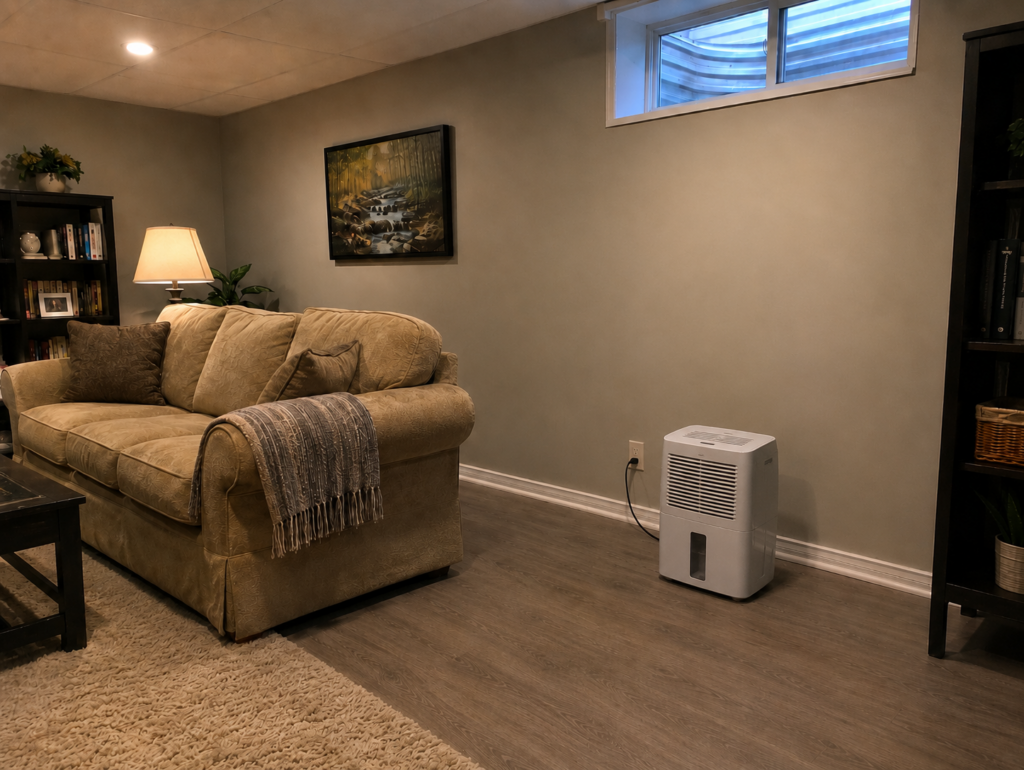
A dehumidifier pulls water out of the air. It does nothing to stop water from pushing in through the walls or floor. Here is how to tell which problem you have.
You likely need waterproofing, not just a dehumidifier, if any of these are true:
A dehumidifier is usually enough only when the air is humid, but the walls and floor stay dry. The EPA recommends keeping indoor humidity below 60 percent, and ideally between 30 and 50 percent.
If you cannot hold that range even with a dehumidifier running, water is coming from the ground, and you need waterproofing.
Before you spend money, run one simple test at home. It tells you whether your moisture is condensation, a humidity problem, or seepage, a groundwater problem.
Tape a square of aluminum foil tightly to a bare section of your basement wall. Seal all four edges with strong tape. Wait 24 to 48 hours, then peel it back and check which side is wet.
Where the moisture shows up | What it means | What fixes it |
|---|---|---|
On the room-facing side of the foil | Condensation. Humid indoor air is hitting a cool wall. | Better ventilation and a dehumidifier. |
On the wall-facing side, or the wall behind it is damp | Seepage. Groundwater is moving through the wall. | Professional basement waterproofing. |
Both sides are wet | You have both problems at once. | Waterproof first, then control the humidity. |
If the moisture is behind the foil, a dehumidifier will never keep up, because the water keeps coming. That is the point where waterproofing pays off.
For most NJ homes with a musty, damp basement, the fix is an interior waterproofing system. It manages groundwater from the inside without digging up your yard, and it works well when the foundation is structurally sound.
Here is how it works, step by step:
United Waterproofing uses a patent-pending version of this system that captures water before it reaches your foundation, using Fast Flow perforated piping, a rust-proof composite sump tank, and a battery backup. You can see the parts on our waterproofing products page. Because the work is done from the inside, it is faster and less disruptive than exterior excavation.
Cost depends on the size of your basement, where the water is coming from, and the system you need. There is no single price, but you can get a sense of the range before you call.
National data from Angi puts the average cost to fully waterproof a basement at roughly $5,200, and the cost runs higher in parts of New Jersey due to local soil and access conditions. For a full breakdown, see our guide on what basement waterproofing costs in New Jersey.
What drives the price:
Factor | Why it changes the cost |
|---|---|
Basement size | Waterproofing is priced by the linear or square foot, so a larger perimeter costs more. |
Water source | Simple condensation is cheaper to manage than groundwater under pressure. |
System type | Crack sealing costs less than a full interior drain and sump system. |
Access | Finished walls or tight spaces add labor and time. |
Backups and extras | A battery backup or second pump adds cost but protects you during outages. |
The only way to get a real number is a free on-site inspection. A written quote should list every part and price, with no vague line items.
The company you hire matters as much as the system. Use this checklist before you sign anything:
United Waterproofing checks every box. We are a family-owned company based in Dover with more than 25 years of experience across Morris County and northern New Jersey.
We use no subcontractors; the owner is on every job, and every system is backed by a 100 percent lifetime transferable warranty. We are registered with the NJ Division of Consumer Affairs and hold an A+ rating with the Better Business Bureau.
Late summer is a smart time to waterproof in New Jersey. The ground is drier, which makes for cleaner access and faster installation. It also means your system is ready before the wet season arrives.
Fall rain and winter freeze-thaw cycles put the most pressure on foundations. Water that seeps in during a cold snap can freeze, expand, and widen cracks. Waiting until then usually means paying for a bigger repair and living with the musty smell through the holidays.
If your foil test showed seepage, or the smell keeps coming back, the problem will not fix itself. Handling it now costs less than handling it after the next storm.
Only if the moisture is coming from humid air, not the ground. A dehumidifier lowers humidity, but it cannot stop water pushing through walls or floors. If the smell returns within days, you have a groundwater problem that needs waterproofing.
That smell after rain points to seepage. Rain raises the water table and increases hydrostatic pressure, which forces groundwater through cracks and pores in the foundation. The moisture feeds mold, and the smell follows.
It can be. The CDC reports that damp, moldy spaces can cause a stuffy nose, coughing, wheezing, and eye or skin irritation, with stronger reactions for people who have asthma or allergies. Removing the moisture source is the real fix.
Efflorescence is the white, powdery residue left on basement walls when groundwater moves through concrete and evaporates. It is not mold, but it is proof that water is passing through the wall.
The EPA recommends keeping indoor humidity below 60 percent, and ideally between 30 and 50 percent. If you cannot hold that range with a dehumidifier, water is likely entering from the ground.
Most interior systems are installed in one to three days, depending on the size of the basement and the amount of prep. A free inspection gives you an exact timeline.
It should. United Waterproofing backs every system with a 100 percent lifetime transferable warranty that also transfers to a future owner and adds value at resale.
DIY sealers and paint may hide the problem for a short time, but they do not relieve the water pressure behind the wall. The moisture returns, often worse. A professional system manages the water at the source.
Check that they register with the NJ Division of Consumer Affairs, carry liability insurance, and display a registration number starting with 13VH. Ask for a written, itemized quote and confirm they use in-house crews, not subcontractors.
Drier late-summer ground makes installation faster, and it gets your system ready before fall rain and winter freeze-thaw cycles put the most pressure on your foundation. Waiting usually means a bigger, costlier repair.