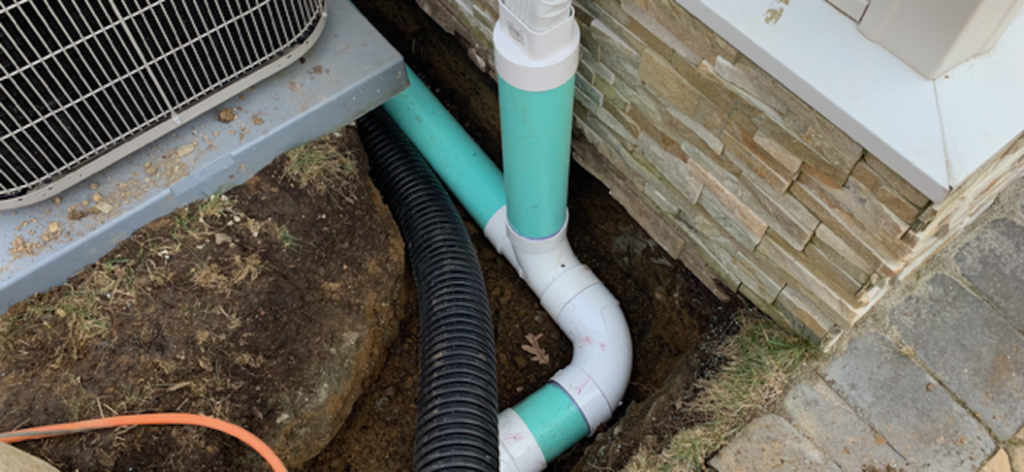
A French drain is a gravel-filled trench containing a perforated pipe that collects groundwater and redirects it away from a structure or low-lying area before it can cause flooding, foundation damage, or basement water buildup.
Despite the name, French drains have nothing to do with France; they are named after Henry Flagg French, a Massachusetts lawyer who described the technique in his 1859 book Farm Drainage.
For North Jersey homeowners, French drains are among the most practical and cost-effective exterior and interior waterproofing solutions for managing drainage problems that the state’s geology and climate consistently create.
Northern Jersey averages 51 inches of precipitation annually, which is approximately 20 inches higher than the U.S. national average. Much of the northern part of the state also sits on poorly-draining silt and clay soils that allow moisture to saturate the soil and exert hydrostatic pressure on the foundation.
For properties with low-lying areas where water collects, a French drain is often the only effective way to eliminate standing water and prevent soil erosion.
This guide explains exactly how French drains work, what installation involves, and how to know whether your property needs one.
A French drain works by providing a path of least resistance for groundwater, using gravity to divert it away from a home’s foundation. It consists of three primary components: a sloped trench, permeable gravel, and a perforated pipe.
The system works passively, meaning no power is required or moving parts. As long as the outlet remains unobstructed and the gravel bed stays clear of fine sediment that can clog it over time, it will channel water quickly from your property.
Sediment management is an essential part of your French drain’s lifespan, as using superior filter fabric can be the difference between a drain that lasts 5 years or 25 years.
Depending on your property’s specific topography and the severity of your water intrusion, New Jersey waterproofing professionals typically utilize one of three primary French drain configurations.
Installed outside the foundation wall, exterior French drains intercept groundwater before it reaches the foundation.
The trench runs along the footing—the base of the foundation—and the pipe discharges water away from the structure. This is the most effective approach for preventing foundation hydrostatic pressure, but it requires excavation to the footing depth, which, in New Jersey’s frost line (approximately 36 to 42 inches), means significant digging.
Installed inside the basement along the perimeter walls, interior French drains collect water that has already entered through foundation cracks, wall-floor joints, or block wall seepage and channel it to a sump pit for discharge.
Interior systems do not stop water from entering the foundation wall; they manage water after it enters, directing it to a sump pump before it floods the floor.
For most homeowners dealing with chronic basement water, interior French drains combined with a sump pump are the most practical solution because they avoid the major excavation of exterior work.
Surface drains are installed across yards, along property lines, or at the base of slopes to redirect surface runoff before it concentrates around a structure. These are common in New Jersey neighborhoods where grading has settled over decades, and water now flows toward rather than away from homes.
Choosing the right solution requires a professional assessment to identify where your home is most vulnerable to water pooling due to uneven grading.
French drains are passive systems often installed alongside other waterproofing systems to keep basements dry and moisture out of your home.
Solution | Best For | Addresses Hydrostatic Pressure? | Requires Power? |
Exterior French drain | Preventing water from reaching foundation | Yes — reduces pressure before it builds | No — gravity fed |
Interior French drain + sump | Managing water that enters basement | Partially — manages water after entry | Yes — sump pump required |
Surface grading correction | Redirecting surface runoff away from structure | No — surface only | No |
Window well drains | Protecting below-grade windows from overflow | No — local only | No |
Waterproof membrane | Sealing foundation wall surface | No — seals entry, not source | No |
French drain installation in New Jersey is not a DIY project for most homeowners. The combination of New Jersey’s heavy clay soils, deep frost lines, and the need for proper grading makes professional installation essential.
Here’s how the process to install a French drain works.
New Jersey requires permits for connections to municipal storm drains, which is why a licensed contractor handles these applications.
French drain installation costs in New Jersey vary significantly based on the system type, trench depth, site conditions, and outlet requirements. The following ranges reflect typical New Jersey market pricing.
System Type | Typical NJ Cost Range | Key Cost Drivers |
Yard French drain (basic) | $1,500 – $4,000 | Linear footage, soil type, outlet location |
Interior perimeter drain + sump | $5,000 – $12,000 | Basement perimeter footage, concrete cutting |
Exterior perimeter French drain | $8,000 – $25,000+ | Excavation depth, foundation length, backfill |
Combined yard + exterior system | $12,000 – $30,000+ | Site complexity, multiple outlet points |
The wide cost range reflects real variation in NJ site conditions. A yard French drain on sandy coastal plain soil is fundamentally different from an exterior perimeter system in Bergen County glacial till, where excavating to footing depth through dense clay adds significant labor and equipment costs.
A properly installed French drain requires minimal maintenance but does have a finite service life determined by how aggressively soil particles migrate into the gravel bed despite the fabric barrier. Most professional French drains in New Jersey perform well for 10 to 25 years before requiring attention.
Use the following maintenance checklist to ensure your drainage remains unobstructed and efficient.
A French drain is only as effective as its filtration and pitch. Because New Jersey’s dense soils are composed of microscopic particles that can easily bypass cheap, thin fabrics, choosing a professional installer is critical.
High-quality, non-woven geotextile fabrics and correctly washed aggregate are the difference between a system that fails in 5 years and one that protects your home for decades.
Investing in an expert ensures the system is pitched correctly to account for your property’s unique topography, preventing stagnant water and ensuring long-term structural protection.
A professionally installed French drain with quality geotextile fabric typically lasts 15 to 25 years in optimal conditions. The primary source of failure is gradual sediment migration into the gravel bed that reduces drainage capacity over time. Quality fabric and proper installation significantly extend service life.
Permit requirements vary by municipality in New Jersey. Connections to municipal storm sewer systems require permits in virtually all municipalities. Significant exterior excavation work may trigger additional permits depending on local ordinances. A licensed waterproofing or drainage contractor will identify applicable permits and handle filings as part of the project.
Shallow-yard French drains are within reach of capable DIYers with access to a trenching machine rental. Exterior perimeter systems and interior basement systems are not DIY projects; the excavation depths, concrete cutting, and proper outlet engineering required for these systems are often too complex for most homeowners.
A French drain is a passive collection and redirection system that moves water by gravity and requires no power. A sump pump is an active discharge device that moves water from a pit to a discharge point. The two work together in most basement water management systems: the interior French drain collects water seeping through the foundation and channels it to the sump pit, and the sump pump discharges it away from the structure. Neither alone is as effective as both in combination.
A French drain addresses drainage failure, such as water accumulating around the foundation due to poor soil drainage or inadequate grading. If your basement water comes from surface water overwhelming the soil's absorption capacity or from hydrostatic pressure building against the foundation wall, a French drain is the correct solution. If water is entering through cracks in the foundation wall above grade, that requires different solutions in addition to or instead of drainage work.