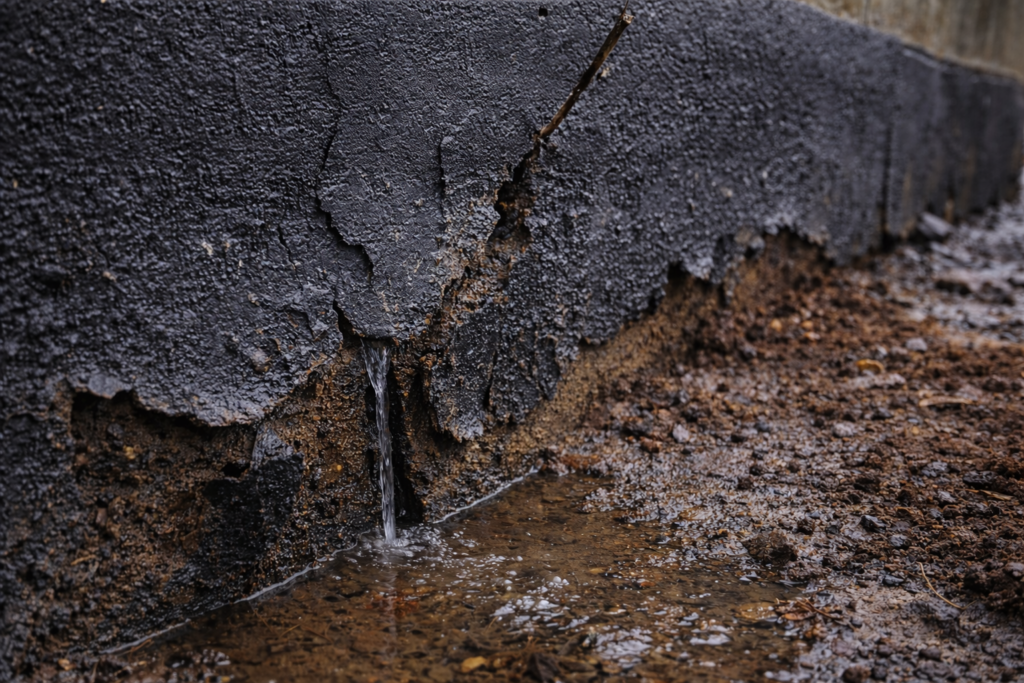
Tar coating, also called asphalt coating or damp-proofing, is a black substance applied to basement foundation walls during construction. Most New Jersey homes built after 1950 have tar coating on exterior foundation walls.
Despite its widespread use, tar coating is not rated to prevent water infiltration in New Jersey’s clay soil and high-water-table conditions.
Tar coating is considered damp-proof, not waterproof. This distinction is important because tar coating is designed only to block moisture, not to prevent water seepage through cracks or under hydrostatic pressure.
The material also cracks and deteriorates within 10 to 15 years after installation.
This guide explains why tar coating fails to stop leaks and moisture in New Jersey basements, the health risks associated with coal-tar-based products, and which waterproofing methods actually prevent basement water infiltration.
Damp-proofing and waterproofing serve different purposes. Damp-proofing blocks moisture vapor transmission through concrete, preventing dampness and minor condensation.
Waterproofing prevents liquid water infiltration under pressure, stopping water from entering when saturated soil pushes against the foundation.
Tar coating is applied in thin layers—typically 1/16 to 1/8 inch thick—that create a barrier against moisture vapor. This thickness is sufficient to stop dampness in well-drained soil with low water tables. However, it is not sufficient to resist hydrostatic pressure in saturated clay soil.
New Jersey building codes require damp-proofing on foundation walls, but do not mandate true waterproofing. Most builders apply tar coating to meet the minimum code requirement because it is inexpensive.
True waterproofing costs three to five times more than tar coating, which is why many builders forgo it to save money.
Not only does tar waterproofing fail to stop leaks, but it will eventually fail to stop water vapor.
Tar coating degrades quickly when exposed to constant freeze-thaw cycles, hydrostatic pressure, and foundation movement. These factors cause tar to crack, peel, and fail within years.
In New Jersey, this failure happens faster because clay soil remains saturated for long periods. When soil expands and contracts against the foundation, tar lacks the flexibility to move with it. Over time, it separates from the concrete, allowing water to migrate behind the coating.
Tar also has no structural strength. It cannot resist sustained hydrostatic pressure.
When groundwater rises after heavy rain, pressure forces water through cracks, cold joints, and porous concrete. The coating may appear intact, but water will bypass it through microscopic gaps or areas where adhesion has failed.
Once tar separates from the wall, it cannot be repaired in place. The entire exterior must be excavated and replaced.
Some older foundation coatings use coal tar pitch instead of asphalt. Coal tar contains polycyclic aromatic hydrocarbons (PAHs), which the EPA classifies as probable human carcinogens.
During application, coal tar releases toxic fumes and volatile organic compounds (VOCs) that pose respiratory and skin hazards.
As these coatings age, PAHs can leach into surrounding soil and potentially migrate toward groundwater.
The U.S. Geological Survey has found significantly elevated PAH levels in dust from coal tar-treated surfaces compared to untreated areas. Due to health and environmental risks, many municipalities have restricted or banned coal tar-based sealants.
Homes built before 1990 in New Jersey may still have coal tar coatings in place. Because of toxic exposure concerns, removal or repair should be handled by professionals, not homeowners.
Effective waterproofing in New Jersey must be engineered to withstand hydrostatic pressure, expanding clay soil, and repeated freeze-thaw cycles. Tar coating was never designed to withstand these forces over the long term.
Modern waterproofing solutions combine pressure relief, drainage control, and durable membrane protection to prevent water intrusion and its return.
If your basement is leaking due to aging or a failed tar damp-proofing system, the following waterproofing products can provide long-term protection in New Jersey.
Modern rubberized asphalt or polymer-modified membranes are applied at a minimum thickness of 60 mils and remain flexible under freeze-thaw conditions. Unlike tar, these membranes stretch and recover with foundation movement.
When paired with drainage boards or dimpled membrane panels, they create a capillary break between soil and concrete. This prevents groundwater from remaining in constant contact with the foundation wall.
The drainage layer directs water downward toward the footing drain, preventing pressure from building. This system stops water at the source.
Perforated footing drains installed at the base of the foundation collect groundwater before it rises to wall height.
Surrounded by clean gravel and properly sloped toward a sump pit or daylight discharge, these systems are designed to continuously reduce hydrostatic pressure against basement walls.
When exterior excavation is not feasible, interior drain tile systems capture water at the floor-wall joint. These systems intercept groundwater at the footing level and redirect it to a sump pump before it reaches finished areas.
Interior systems do not stop water from entering the wall itself. They control it before flooding occurs.
In many New Jersey homes built before 1980—especially those without exterior drains—interior systems are often the only viable retrofit solution.
Before any membrane or drainage system is effective, cracks must be permanently sealed. Polyurethane injection stops active water intrusion by expanding within the crack. Epoxy injection restores structural continuity in load-bearing walls.
Surface patches fail because they do not bond internally within the crack. Proper injection seals cracks from the inside out.
Even the best waterproofing system can be overwhelmed by poor grading.
Correct surface management helps divert water away from the foundation to prevent soil saturation and pressure against basement walls. Best practices include:
Reducing surface saturation lowers the total groundwater load placed on the foundation.
Combined, these waterproofing systems deliver better long-term water management and help keep your basement dry.
If your New Jersey basement leaks despite having tar coating, it means the coating has failed. Adding more tar will not fix the problem.
Effective waterproofing can reinforce basement walls and manage surface runoff, helping them withstand the conditions that cause tar coating to fail.
Tar coating has likely failed due to cracking, peeling, or separation from the concrete. The coating may still be visible on the exterior wall, but no longer provides protection. Tar coating is damp-proofing, not waterproofing, and cannot resist hydrostatic pressure.
No. Applying additional tar coating over failed tar does not solve the underlying problem. The new coating will fail for the same reasons the original failed: inadequate thickness, poor flexibility, and inability to resist hydrostatic pressure. Effective waterproofing requires removing failed tar and installing proper membranes with drainage systems.
Tar coating typically lasts 10 to 15 years in ideal conditions. In New Jersey's clay soil with freeze-thaw cycles, it often fails within 5 to 10 years. Homes built in the 1980s or earlier likely have completely failed tar coatings, even if they appear intact from the exterior. The coating becomes brittle, cracks, and loses adhesion over time.
Yes. Coal tar-based coatings contain polycyclic aromatic hydrocarbons (PAHs), which are classified as probable human carcinogens by the EPA. Coal tar releases toxic fumes during application that cause skin irritation and respiratory problems. As the coating degrades, PAHs leach into soil and can contaminate groundwater. Do not attempt to remove or repair coal tar coatings without proper protective equipment and professional guidance.
Use rubberized waterproofing membranes at 60 mils or thicker, drainage boards to create air gaps, and functional footing drains. For existing basements where exterior waterproofing is not feasible, install interior drain tile systems that collect water at the floor-wall joint and pump it out. Proper waterproofing requires multiple components working together, not a single coating.
Yes. Signs of failed tar coating include water infiltration at the floor-wall joint, dampness or efflorescence on basement walls, visible cracks in the foundation, and musty odors or mold growth. If your basement shows any of these symptoms, the exterior tar coating has failed or was inadequate from the start. Interior inspection cannot confirm exterior coating condition, but symptoms indicate failure.