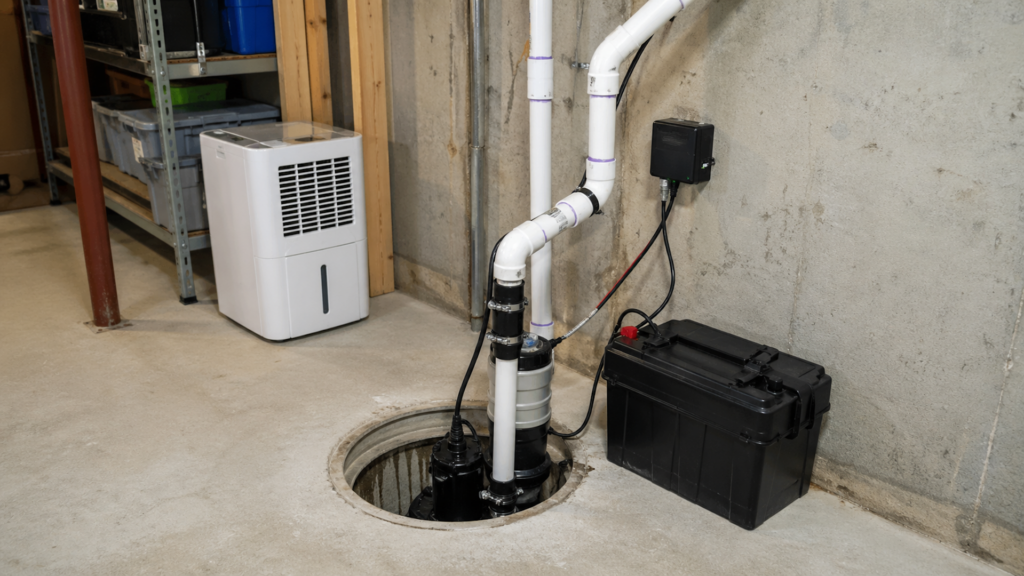
A sump pump battery backup is a secondary pump system powered by a dedicated battery that automatically activates when your primary pump loses power, fails mechanically, or cannot keep up with the volume of incoming water.
Heavy storms are common in the region as New Jersey experiences 20 inches of precipitation above the national average. Unfortunately, JCP&L customers experience some of the highest outage frequencies in the country, rendering their mechanical sump pumps inoperable when they’re needed most.
The Insurance Information Institute ranks sump pump failure among the most common homeowner water damage claims in the Northeast. For the minor cost of $800 to $2,000 installed, a battery backup system ensures your basement is always protected from potential flooding and gives you peace of mind when the lights go out.
A battery backup system installs a second pump in the same pit as your primary pump, connected to a dedicated deep-cycle battery kept charged by a trickle charger on AC power.
When grid power fails, the backup pump automatically switches to battery power, requiring no manual intervention. A monitoring panel alerts you to power loss, low battery voltage, high water levels, and pump failures, with most modern systems offering smartphone notifications.
There are two primary system types available on the market:
A separate pump draws from a dedicated AGM or lead-acid battery and can run 5 to 12 hours of continuous pumping on a full charge, significantly longer with intermittent cycling. Brands including Zoeller, Liberty Pumps, and Wayne offer well-tested systems in this category.
This system uses municipal water pressure, via a venturi, to lift sump water, with no battery required. This provides unlimited runtime as long as the pressure holds.
The trade-off is lower capacity (1,200 to 2,000 GPH vs. 2,000 to 5,000+ GPH for battery systems) and inefficiency (roughly 1 gallon used per 2 gallons pumped). Water-powered backups are best suited as a supplemental backup when municipal pressure is stable, but not as a primary backup solution for homes with serious water-table issues.
Standard sump pump systems are insufficient to handle extreme weather conditions without a battery backup, as grid fragility and more frequent storms raise the likelihood of outages. Some reasons we make sump pumps battery backups standard in all of our waterproofing systems include:
Battery backup systems vary significantly in capacity, battery quality, and monitoring. While a professional will guide you to the best choice based on their internal criteria, these are the specifications that determine how a system performs when it matters.
For most New Jersey homeowners whose primary concern is basement flooding during power outages, a dedicated battery backup is the right starting point. A generator is a separate investment that addresses broader needs but should not be treated as a substitute for a pump-specific backup system.
Battery Backup System | Standby Generator | |
Typical installed cost (NJ) | $800 – $2,000 | $8,000 – $20,000+ |
Sump pump protection | Yes — automatic | Yes — if transfer switch installed |
Run time during outage | 5–12 hrs continuous pumping | Days (fuel dependent) |
Maintenance | Battery replacement every 3–5 years | Annual service, fuel management |
Protects other appliances? | No — sump pump only | Yes — whole home |
Best for NJ homes… | …with basement water risk, no other backup | …with medical equipment or frequent outages |
Installation costs for a sump pump battery backup in New Jersey range from $800 to $2,000, depending on system type, pump capacity, and battery specification.
Battery replacement every 3 to 5 years runs $150 to $400, depending on battery type, which is the primary ongoing maintenance cost.
A battery backup system that remains idle for 18 months or longer risks failure during a critical weather event. Regular maintenance ensures the system remains mission-ready.
Begin with a monthly visual inspection of the monitoring panel to confirm that all indicators are green, indicating the battery is charged, and the pump is functional.
Every three to six months, perform a functional test by disconnecting the primary pump from its power outlet and filling the sump pit with water until the backup pump activates. This confirms that the secondary motor and float switch are operational and that the battery can hold a voltage under a live load.
Schedule an annual professional load test to verify the battery’s health; any unit operating below 80% of its rated capacity requires replacement to ensure reliability.
Finally, after every major storm, inspect the control panel to see if the backup was triggered. If it was utilized, ensure the battery recharges fully and document the event in your maintenance records.
In New Jersey, a sump pump battery backup protects you during the worst storms and power outages. United Waterproofing includes battery backups as a standard component of every installation, ensuring homeowners have built-in redundancy against mechanical pump failures and electrical surges.
Most quality DC systems run 5 to 12 hours of continuous pumping on a full charge, significantly longer with intermittent cycling. For northeasters and tropical storm remnants—which can produce flood conditions for 12 to 24 hours—choose a system with at least 75 amp-hour battery capacity and a backup pump rated at 2,400 GPH or higher.
Quality systems include surge protection on the AC charger input. The backup pump itself runs on DC battery power during operation and is inherently isolated from AC surges. A whole-home surge protector at the main panel provides the most comprehensive surge protection for all connected systems, including the charger.
If your primary pump is more than 7 to 10 years old and you are investing in a new backup, replacing both simultaneously is the most cost-effective approach. Installing a new backup on an aging primary means facing the primary pump's failure shortly after, resulting in two service visits instead of one. Both pumps installed together also allow the contractor to verify the pit size and discharge configuration, which handles both systems.
The monitoring panel confirms readiness via status indicators: AC power present (charger operating), battery charge level, and pump operational status. All green means ready. The only way to confirm the pump actually works under load is to manually test it by disconnecting the primary and pouring water into the pit.
For most homeowners whose primary concern is basement flooding, a battery backup system is the right first investment. A generator adds broader whole-home protection but at a significantly higher cost and maintenance burden. If you have medical equipment that requires power, frequent multi-day outages, or a sump pump running continuously for extended periods, a generator becomes a more compelling addition to your backup system.