
Basement leaks from cracked walls and poor drainage are not the only sources of moisture intrusion. Even after plugging cracks and gaps in your basement, you may still notice dampness due to poor ventilation, condensation, or crawl space moisture.
In addition to the heavy rainfall north and central New Jersey experiences year-round, the region also boasts a humid continental climate, leading to increased humidity during peak summer months.
Many older homes in the region suffer from poor basement ventilation, which traps moist air, enabling mold to settle on surfaces and proliferate.
According to the National Institute for Occupational Safety and Health, 47% of US residential homes have visible mold, with basements being the most common area for mold.
While dehumidifiers and fans can help reduce humidity, the best long-term solution for reducing basement dampness in New Jersey is to invest in a waterproofing system with proper ventilation.
This guide will discuss ways to diagnose basement dampness and provide expert solutions to reduce
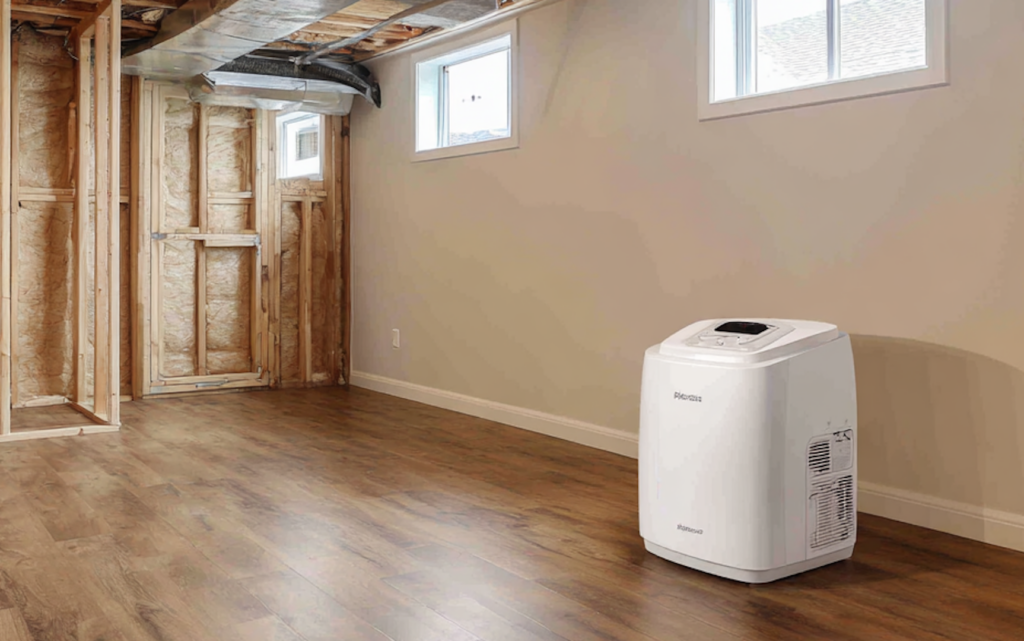
Even after exterior waterproofing or crack repairs, basements and crawl spaces often remain damp due to condensation. This happens when warm, moist air comes into contact with cooler surfaces like floor joists, foundation walls, and the underside of floorboards.
This issue is especially common when:
Moisture condenses on structural components, then slowly spreads upward through wall cavities. Over time, this can affect insulation, drywall, indoor air quality, and even flooring on upper levels.
One of the most overlooked moisture sources in basements and crawl spaces is the ground itself.
Bare soil constantly releases water vapor. Without a barrier, that moisture rises directly into the space, increasing humidity levels and feeding condensation. This is why covering a dirt floor with a vapor barrier is the essential first step in any long-term moisture control strategy.
Unfortunately, without a vapor barrier, ventilation alone cannot solve a moisture problem.
Balanced airflow will control humidity and prevent moisture from forming on cool surfaces.
In colder regions like North Jersey, your ventilation must adapt with the seasons.
Cold winter air holds significantly less moisture than warm summer air—often up to five times less. This means you can reduce airflow and still control humidity effectively.
During winter months, we recommend partially closing foundation vents–leaving some airflow to prevent moisture buildup.
Conversely, completely sealing vents in winter can actually trap moisture.
While basement walls and floor joists are critical for maintaining steady temperatures, insulating your floor can be a good strategy to control moisture and improve ventilation.
Insulating the subfloor also helps maintain warmer surface temperatures and reduces the chance that moisture will collect on joists and floorboards.
Insulation works best when paired with vapor barriers and ventilation.
Installing ventilators correctly ensures long-term performance and structural integrity.
Follow these steps to install foundation ventilators properly and ensure balanced airflow:
Proper installation prevents air leaks, pest intrusion, and water penetration while maintaining controlled airflow.
Many first-time homeowners overlook the problems basement moisture can cause, especially because mold often forms behind wall and floor joist surfaces.
Long-term moisture exposure can lead to several structural and health issues, including:
Moisture problems rarely resolve themselves. The longer they persist, the more expensive they become.
Even without visible leaks, moisture issues often reveal themselves in subtle ways, including:
Ignoring these signs can allow moisture damage to spread into living areas.
If you’re noticing persistent moisture issues in your basement after sealing leaks and installing ventilators, contact a basement foundation repair and waterproofing specialist to inspect your basement for potential solutions.
Moisture often comes from condensation and ground vapor, not liquid water intrusion. Poor ventilation and dirt floors are common causes.
Yes. Vapor barriers stop ground moisture, but ventilation removes humidity from the air.
Typically, one vent per 300 square feet of floor area, with at least two on opposite walls.
They should be partially closed, not sealed completely, to balance moisture control and heat retention.
Yes. Bare soil releases moisture continuously and should always be covered with a vapor barrier.
Yes. Insulating the subfloor reduces condensation by keeping surfaces warmer.
Dehumidifiers help but work best as a supplement, not a replacement for proper ventilation.
If moisture persists despite vapor barriers and ventilation, a professional evaluation is recommended.