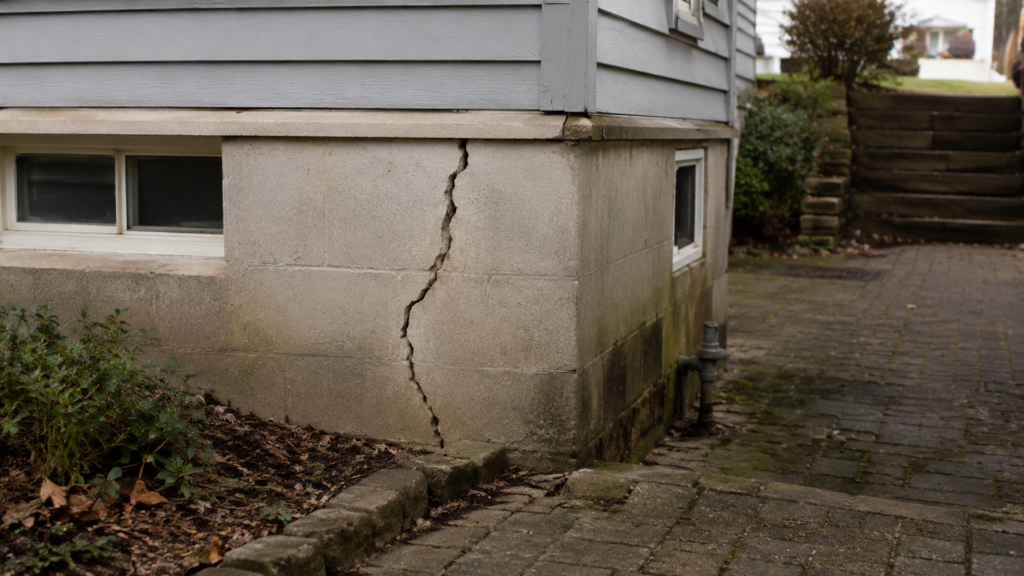
Foundation cracks in New Jersey are primarily caused by soil expansion and contraction due to hydrostatic pressure after heavy rainfall and natural freeze-thaw cycles during the winter.
As clay-heavy soils absorb water and swell, or freeze and expand, they exert immense pressure against basement walls, leading to structural or cosmetic fractures.
While many hairline or vertical fractures are simply a natural byproduct of a home settling over time, others can signal a developing structural issue. Factors such as poor yard drainage, active tree root growth, and aging construction materials can accelerate this damage, often allowing moisture to seep into subterranean spaces.
Understanding the differences between harmless settling and serious structural failure is essential for protecting your property.
This article breaks down the specific types of foundation cracks common in New Jersey homes, how to accurately measure and monitor them, and the different foundation repair methods.
New Jersey’s distinct climate and diverse geology place immense, year-round stress on residential foundations. From the coastal plains to the northern highlands, several regional factors commonly trigger foundation shifting and cracking:
Not all foundation cracks are created equal; analyzing their direction, size, and location is the first step in determining whether a fracture is a minor cosmetic blemish or a major structural threat.
Vertical cracks run straight up and down or within about 30 degrees of vertical. They are the most common crack type in New Jersey’s poured concrete foundations and the least structurally alarming when they are narrow, stable, and not accompanied by displacement.
Thin vertical cracks in poured concrete walls are typically caused by concrete shrinkage during curing and are a normal feature of the material’s aging. They become a concern when they are wider than 1/4 inch, show signs of active water intrusion, or widen over time.
Any vertical crack that is actively leaking water requires professional evaluation and waterproofing treatment, even if the structural significance is limited, because the water-entry pathway it represents will not seal itself.
However, a vertical crack in a block foundation along mortar joints can indicate significant stress.
Horizontal cracks are the most serious crack pattern in residential foundations and require professional evaluation without delay.
Horizontal cracks indicate that the lateral pressure from the surrounding soil has exceeded the structural capacity of the wall. The wall is flexing inward under load.
This is most commonly seen in concrete block foundations, where horizontal cracks develop at mid-wall height—the point of maximum bending stress from lateral soil pressure.
Horizontal cracks can develop within years of initial construction if drainage conditions are poor.
The urgency of a horizontal crack is determined by its width and by how much inward displacement has occurred. Two inches of inward movement from plumb is the standard benchmark beyond which structural intervention becomes critical.
A horizontal crack that is actively widening, accompanied by wall bowing, or present in a wall supporting structural loads above it, requires immediate professional assessment.
Diagonal cracks run at an angle across a poured concrete wall, typically starting from a corner of a window or door opening.
Stair-step cracks follow the mortar joints in a block or brick foundation in a zigzag pattern.
Both indicate differential settlement.
Minor diagonal cracks at window corners are common and often reflect stress concentration at the opening rather than significant settlement.
However, if one side of the crack is higher than the other, or if the two sides are at different depths, the foundation has shifted and the crack is not merely a surface feature. Cracks with displacement require structural assessment.
Any crack where one side has shifted relative to the other is a shear crack. The displacement indicates that the foundation has actually moved at the crack location, not just opened from tensile stress.
Shear cracks are always structurally significant regardless of their width.
In New Jersey homes, shear cracks most commonly appear in poured concrete foundations undergoing significant differential settlement or in block foundations where individual blocks have shifted out of plane.
Even a small displacement at a crack should be evaluated by a structural engineer or experienced waterproofing contractor.
Cracks at the joint where the foundation wall meets the floor slab are common in New Jersey basements and are typically caused by differential movement between the wall and the slab rather than failure in either structural element.
‘The wall and the slab are separate pours that move somewhat independently.
Wall-floor junction cracks act as water entry points rather than as structural concerns.
Sealing this joint with appropriate materials is a standard component of interior waterproofing installation.
While every situation is unique, you can use the crack’s width as a general guideline to determine its severity and the required action:
Crack Width | Typical Significance | Recommended Action |
Less than 1/16 inch | Usually cosmetic; common sign of natural home settling. | Monitor periodically for changes. |
1/16 to 1/8 inch | Minor movement; should be watched closely. | Document with photos; seek professional advice if it grows. |
Greater than 1/8 inch | Often indicates active structural movement or shifting. | Professional inspection is highly recommended. |
Greater than 1/4 inch | Serious settlement or severe lateral wall pressure. | Structural assessment is strongly recommended. |
A foundation crack is considered serious when it is accompanied by secondary symptoms of structural movement, such as bowing basement walls, sticking doors or windows, sloping floors, or active water leaks.
While an isolated hairline fracture is often a harmless sign of a home settling, multiple structural changes occurring simultaneously indicate active foundation failure.
To determine if a crack requires immediate professional attention, look for these warning signs throughout your property:
As a general rule, an isolated hairline crack simply warrants close monitoring. However, the more of these warning signs that appear simultaneously, the more likely it is that active, serious foundation movement is occurring.
You can monitor a foundation crack by marking its endpoints with a pencil, measuring its maximum width, and checking for changes every 30 days over a full seasonal cycle.
If the crack widens, lengthens, or shifts out of alignment, it is considered an active crack that requires professional evaluation.
To accurately track whether a foundation crack is stable or actively growing, follow this step-by-step process:
Active cracks require professional inspection regardless of their current size.
Continuous movement proves that the underlying forces—whether hydrostatic pressure, soil settlement, or regional freeze-thaw cycles—are still aggressively working against your home.
Foundation cracks are repaired using four primary methods, depending on the damage: epoxy injection for dry structural cracks; polyurethane foam for active water leaks; carbon fiber straps or wall anchors for bowing structural walls; and interior drainage systems to permanently relieve groundwater pressure.
Choosing the right repair method depends entirely on whether the fracture is a structural threat or a water mitigation issue.
Epoxy injection is the industry-standard repair method for restoring structural integrity to poured concrete walls.
A two-part epoxy resin is injected under high pressure through specialized ports, filling the fracture from the inside out. When fully cured, the epoxy fuses the concrete back together, creating a permanent bond that is actually stronger than the original wall.
Polyurethane foam injection is the preferred solution for sealing actively leaking foundation cracks.
The liquid foam is injected into the fissure where it reacts with invading moisture, expanding rapidly to form a flexible, completely waterproof barrier.
In New Jersey, where foundations experience ongoing seasonal movement in clay soils and freeze-thaw cycles, polyurethane’s flexibility allows it to stretch with minor wall shifts, whereas rigid epoxy would simply snap and re-crack.
When a foundation crack is accompanied by wall bowing, bulging, or inward displacement, the soil’s lateral structural pressure has exceeded the wall’s capacity.
In these cases, superficial crack injections are insufficient. Contractors apply two heavy-duty structural stabilization methods:
Crack repairs only treat the symptom, not the underlying cause.
In New Jersey areas plagued by dense clay and high groundwater tables, hydrostatic pressure will continuously push against your basement.
If you simply plug a crack, that water pressure will eventually force open a new fracture right next to the old one.
A permanent solution pairs structural crack repair with an interior perimeter French drain and a heavy-duty sump pump system to capture and reroute groundwater before it ever builds damaging pressure against your walls.
Professional waterproofing is always the safest long-term solution to prevent water contact with foundation walls and keep your basement dry.
Tiny hairline vertical cracks are very common and usually just a normal sign of concrete shrinking as it cures or a home settling over time. However, horizontal cracks, zigzagging stair-step cracks in block walls, or any crack that is wider than $1/4$ inch or shifting are not normal. Because New Jersey’s clay soils hold so much water pressure, you should always err on the side of caution and have cracks checked sooner than you would in other states.
Very serious. A horizontal crack is a major red flag that means the soil outside is pushing harder than your basement wall can handle, causing the wall to bow inward. Do not spend time monitoring a horizontal crack. If it is widening, actively leaking, or if the wall is visibly bulging, it is a structural emergency that requires immediate professional repair.
A structural crack means the safety and stability of your home is compromised (like horizontal cracks, bowing walls, or cracks where one side sticks out further than the other). A cosmetic crack is just a surface blemish that doesn't threaten the home's stability (like a tiny vertical shrinkage crack). The big difference is that cosmetic cracks usually just need a quick seal to keep water out, while structural cracks need heavy-duty reinforcement to keep the house safe.
DIY patches using caulk or hydraulic cement from a hardware store only cover the surface—they do not fill the crack all the way through the wall and will eventually leak. Professional repairs use high-pressure injections to seal the crack through its entire depth. More importantly, if your wall is bowing or shifting, DIY is never an option; you need specialized structural equipment to safely stabilize the wall.
Not always, but in New Jersey, it usually goes hand-in-hand. A crack might be dry today, but because NJ clay soil traps water, that same crack will likely leak during the next heavy downpour or spring snowmelt. A professional can look at your yard's drainage to tell you if a simple crack repair is enough, or if you need an interior drainage system to keep your basement permanently dry.
A proper professional repair can last a lifetime, but only if the root cause is fixed. A professional epoxy injection creates a bond stronger than the original concrete. However, if the heavy water pressure outside isn't relieved, the earth will simply force a brand-new crack to open up right next to the old repair. Pairing the crack fix with an interior drainage system is the only way to ensure the repair lasts forever.